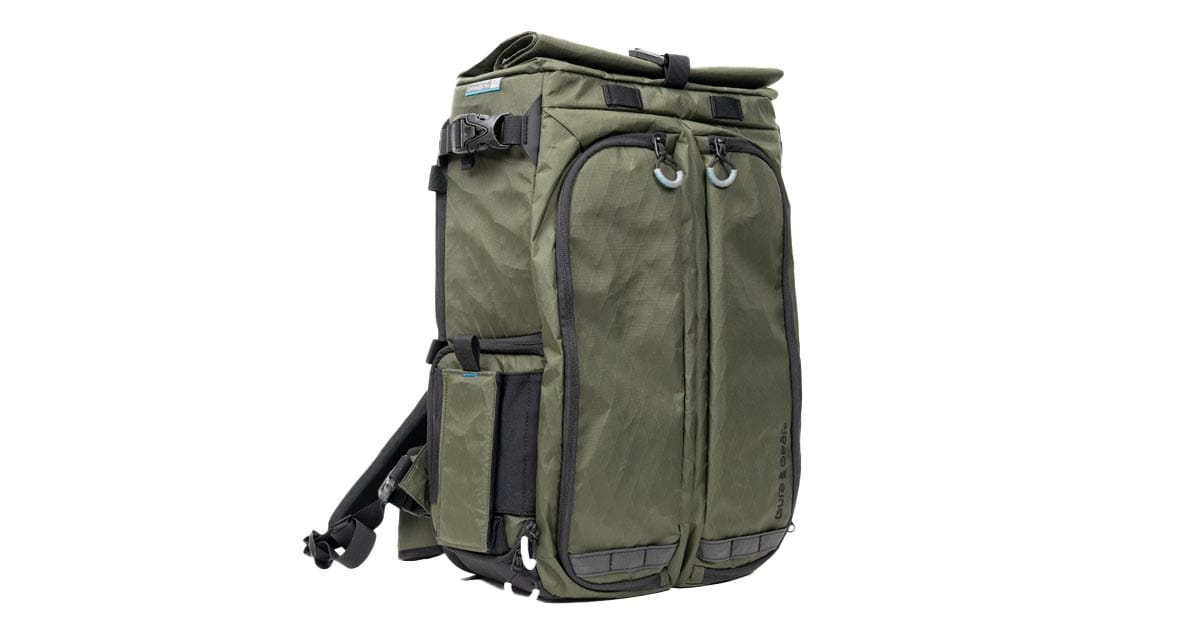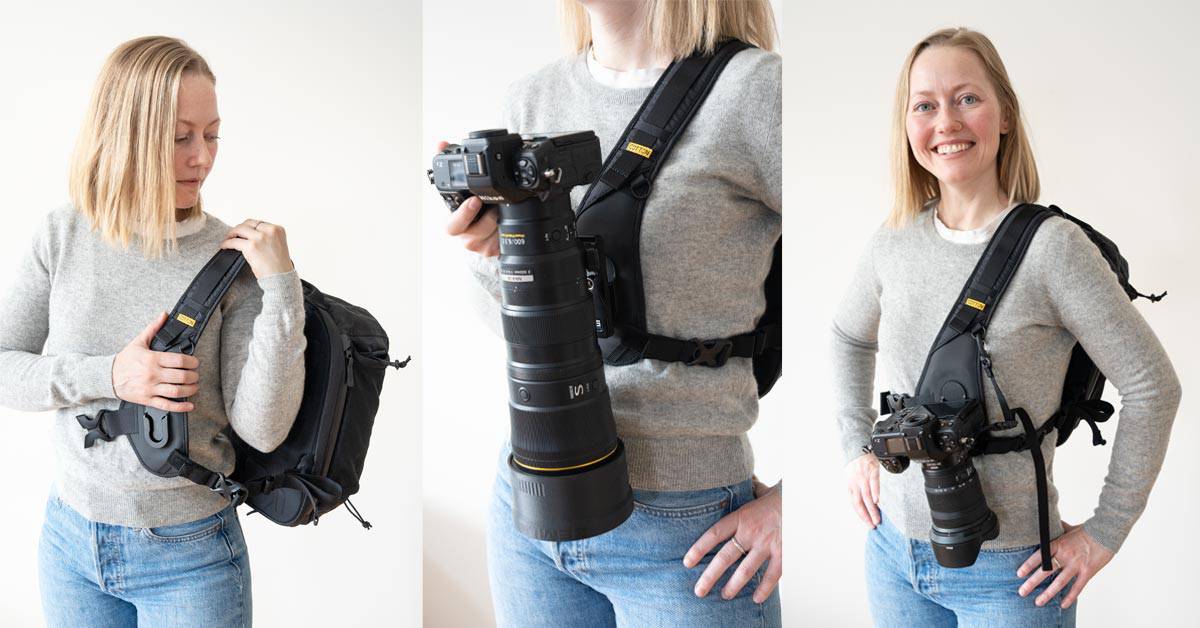
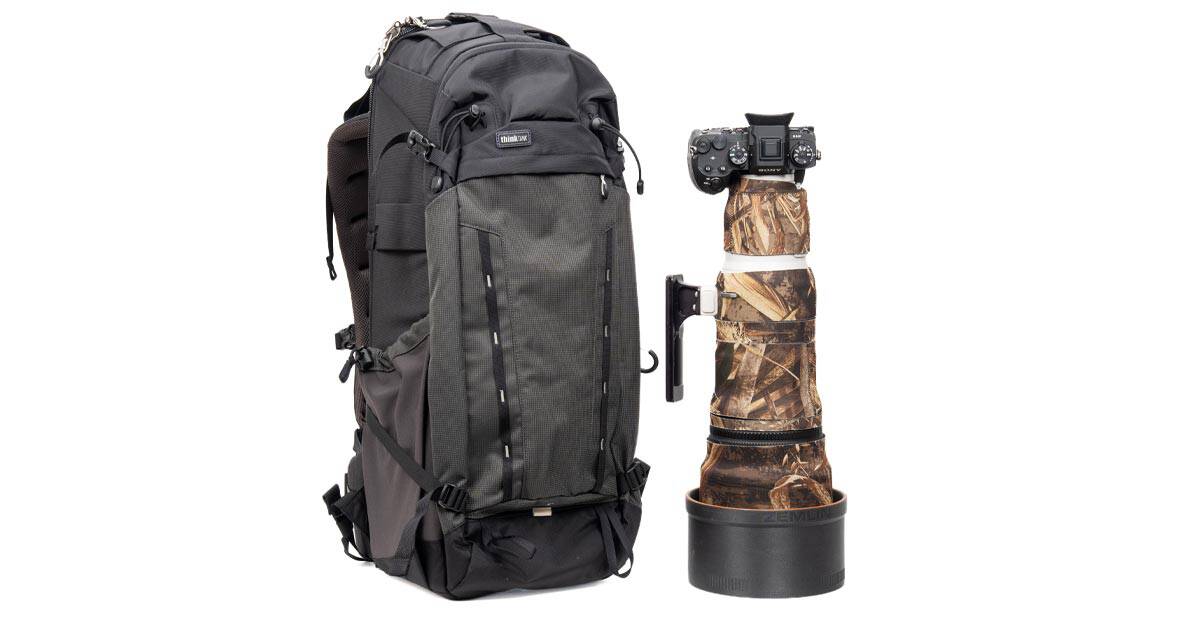
Think Tank Photo’s BackLight range of camera backpacks for outdoor photographers adds a new model: the taller, slimmer BackLight Long Lens bag, designed for wildlife photographers who want to carry super telephoto lenses with attached cameras. The Long Lens variation builds on the established effectiveness of the many size variations in the existing BackLight range, which was sold for a time under the MindShift banner – a Think Tank sister company that has since been reabsorbed into the main brand. Whatever the name on the label, the BackLight range has always been popular, so let’s dig deep into the US brand’s latest offering to see how well it works for those who carry big lenses.
Disclosure: Think Tank Photo sent me the BackLight Long Lens for this review. No money changed hands, and they were not allowed to see the review before it was published. If readers buy through their store links or other store links on this page, I may make a small commission.
Think Tank BackLight Long Lens Specifications
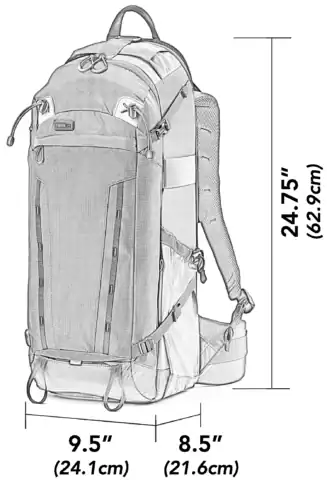
| Exterior Dimensions | 9.5″ W x 24.75″ H x 8.5″ D (24.1 x 62.9 x 21.6 cm) |
| Interior Dimensions | 8.25″–8.5″ W x 22.75″ H x 6.5″–8″ D (21–21.6 x 57.8 x 16.5–20.3 cm) |
| Tablet Sleeve | 8.25″ W x 13.5″ H x 0.875″ D (21 x 34.3 x 2.2 cm) |
| Weight | 4.8 lbs (2.16 kg) including accessories |
| Volume | 32 Liters (1,953 cu in) total – 7L in front pocket |
| Max Lens Compatibility | 800mm f/5.6 or 600mm f/4.0 with gripped body, adapter/teleconverter |
| Back Panel Mesh | 320G Air Mesh |
| Shell Fabric | 420D Dynatec Nylon |
| Interior Fabric | High-Density Velex |
| Padding | Closed-Cell PU Foam |
| Zippers | YKK RC Fuse (lockable) |
| Rain Cover | Realtree APX Camo (included) |
| Price | $275 USD at review time (check current price) |
BackLight Long Lens Key Features
- Opens from the rear panel so you can reach your gear with the pack upright or lying flat
- Second opening on the front gives you an alternate way into the main compartment
- Lockable hook closure keeps the photo compartment from popping open under a heavy load
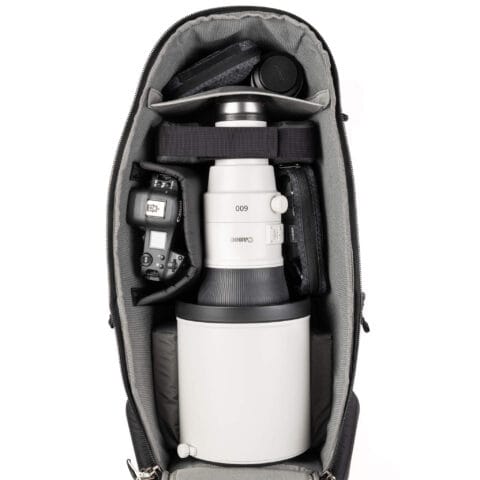
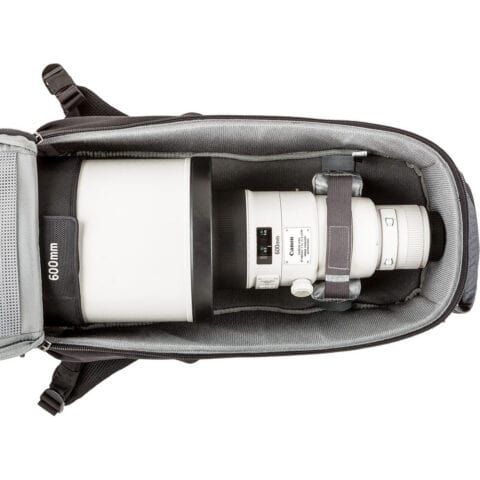
- Deep single compartment built around a gripped body and super-telephoto lens with tripod foot attached
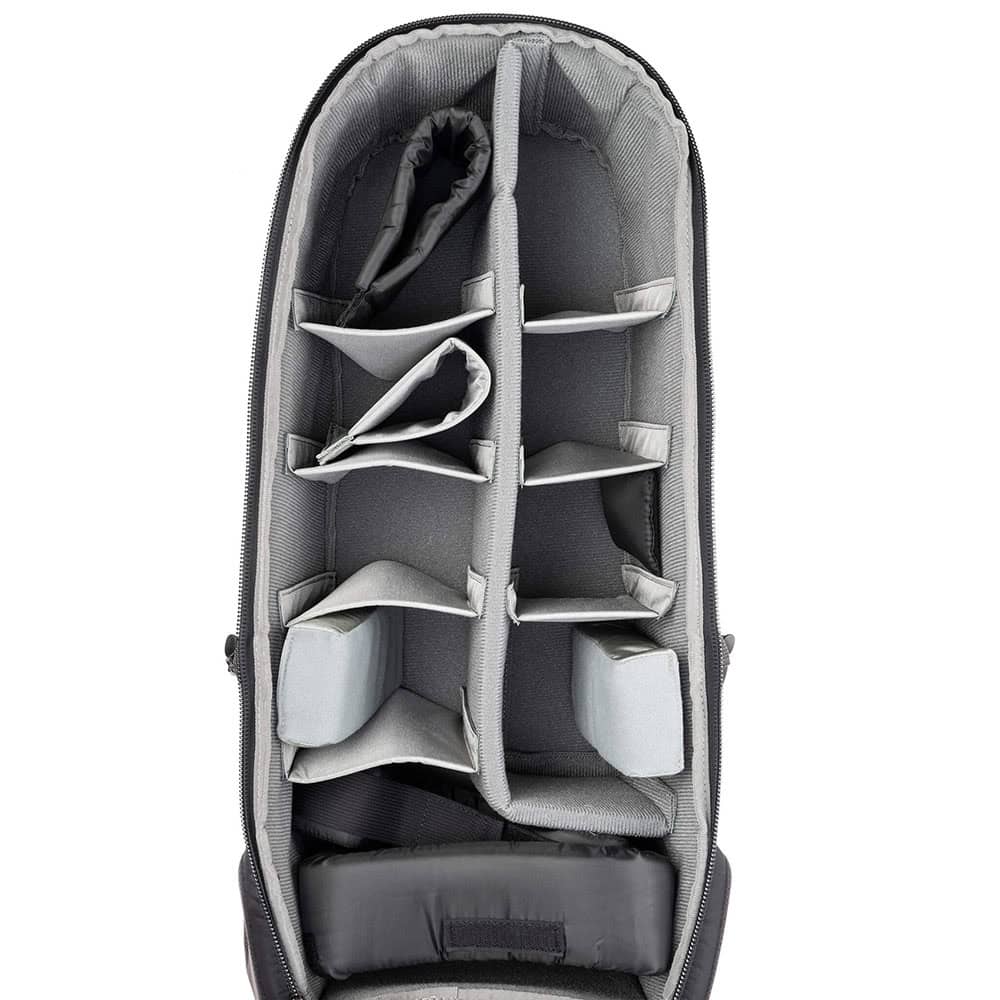
- Customizable divider kit with pillows, a padded yoke, and a lens hood collar for different lens/body setups
- Room to leave the lens hood mounted in reverse without it crowding the lens
- Separate front pockets for non-photo items like a jacket or snacks
- Quick-grab front pocket for small essentials like a headlamp or charger
- Padded sleeve built in for a tablet
- Nine-point adjustable harness with load lifters to shift weight onto your hips
- Sternum strap and quick-release waist belt for extra stability
- Ventilated mesh back panel with an air channel for cooling
- Tripod/monopod mounts on the front and side
- Daisy-chain webbing and loops for lashing on trekking poles or extra gear
- Side compression straps with locking buckles that double as attachment points
- Side rails compatible with Think Tank’s modular accessory system
- Includes a camouflage rain cover
What Fits in the Think Tank BackLight Long Lens Backpack
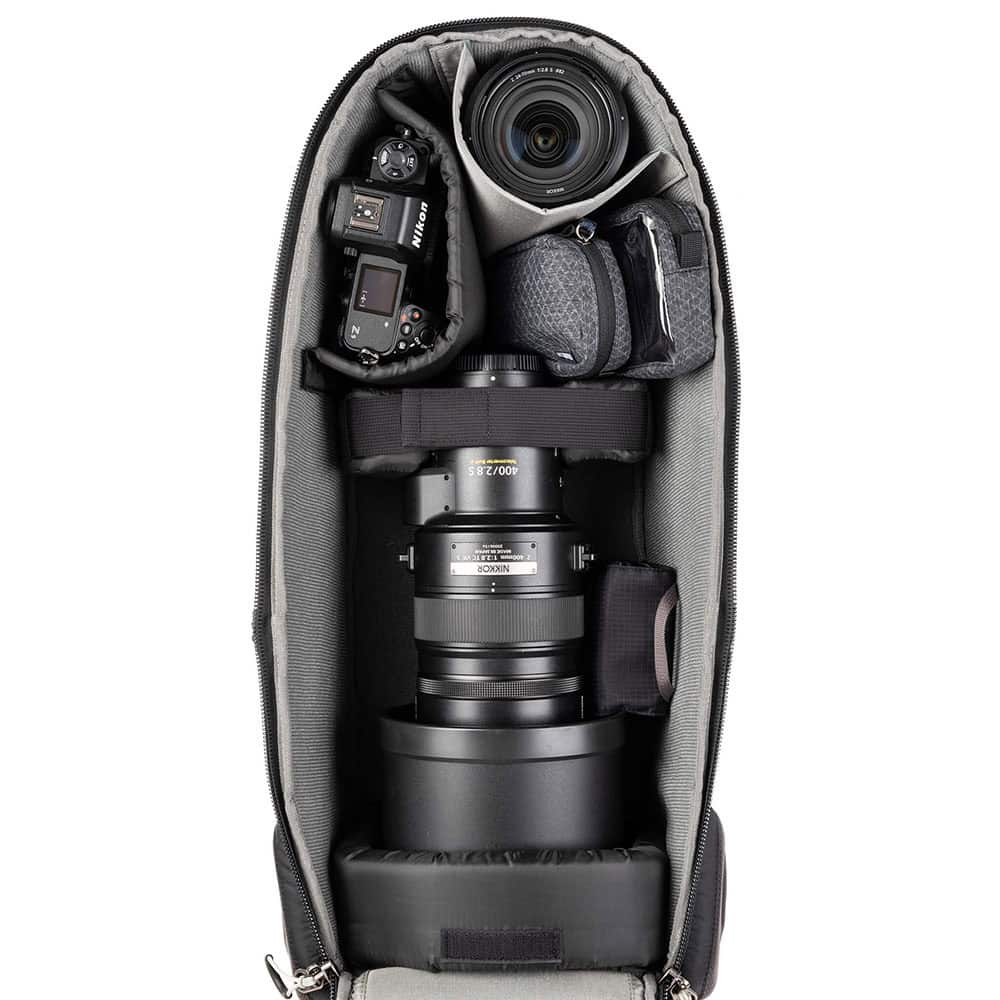
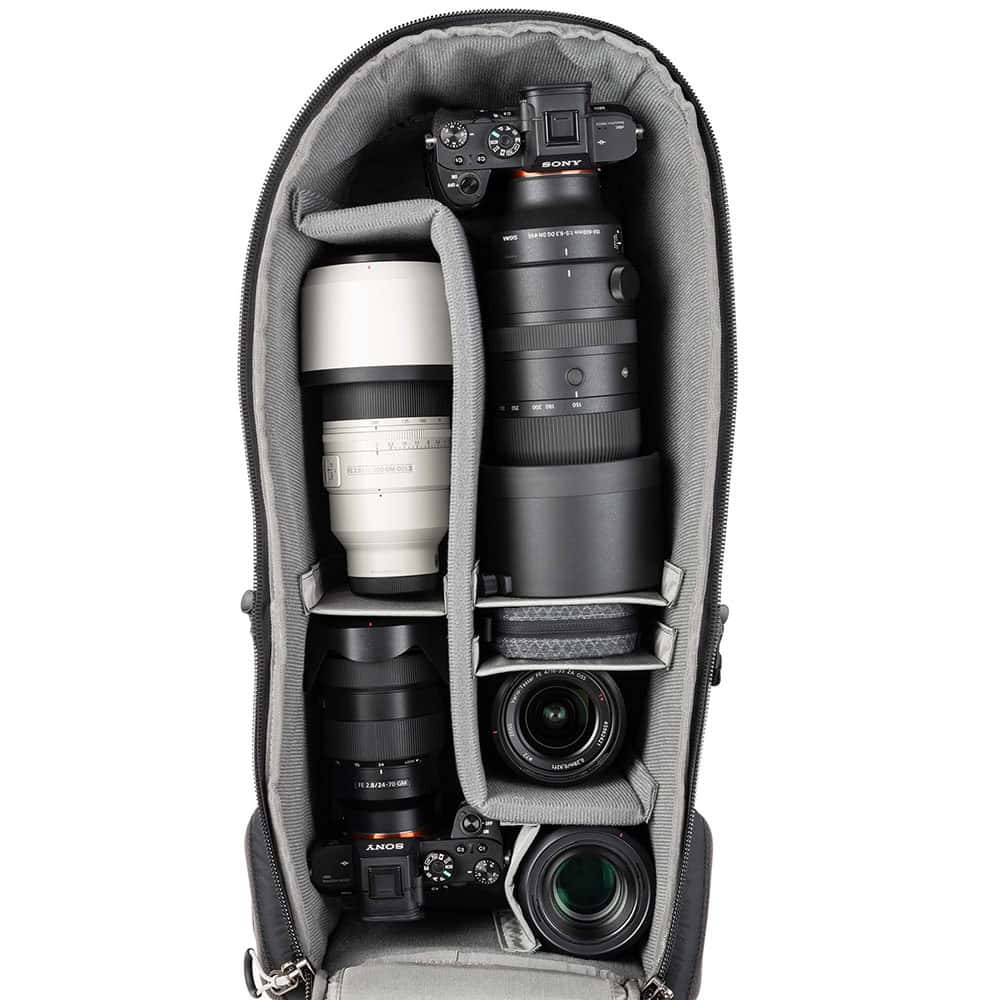
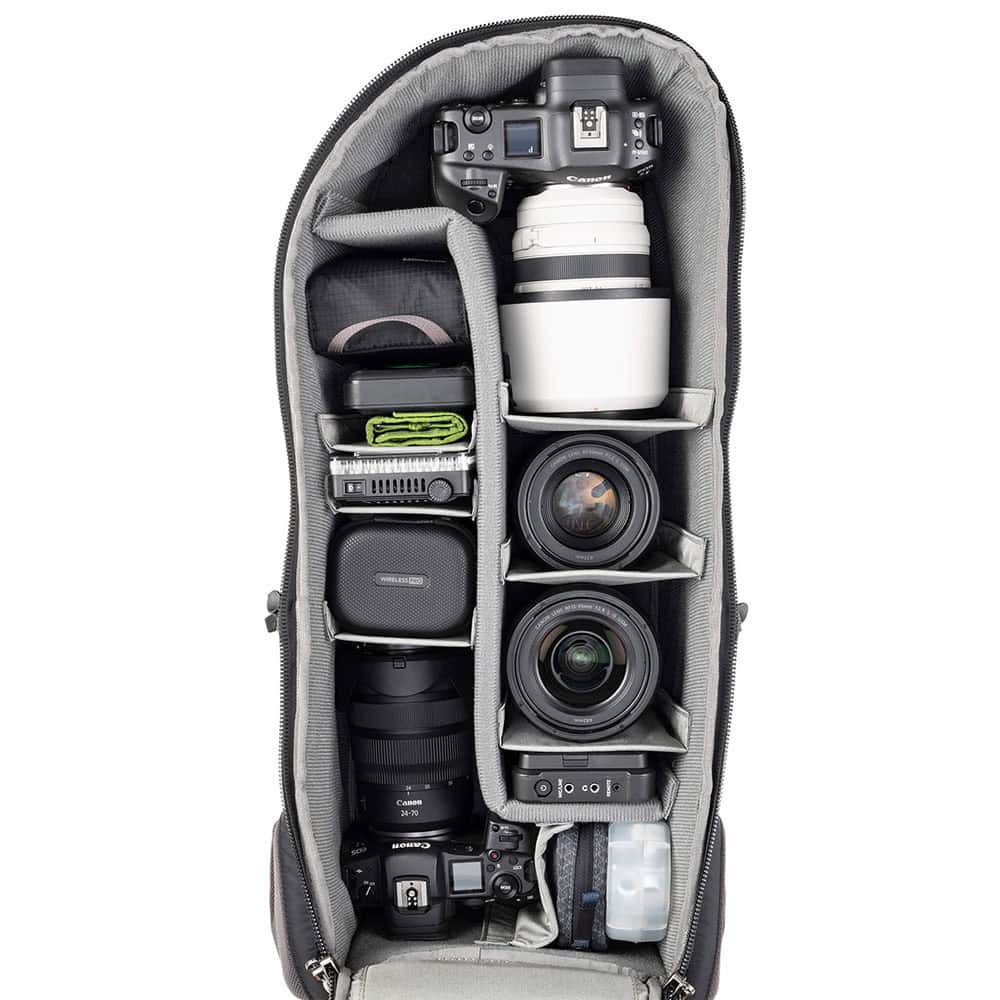
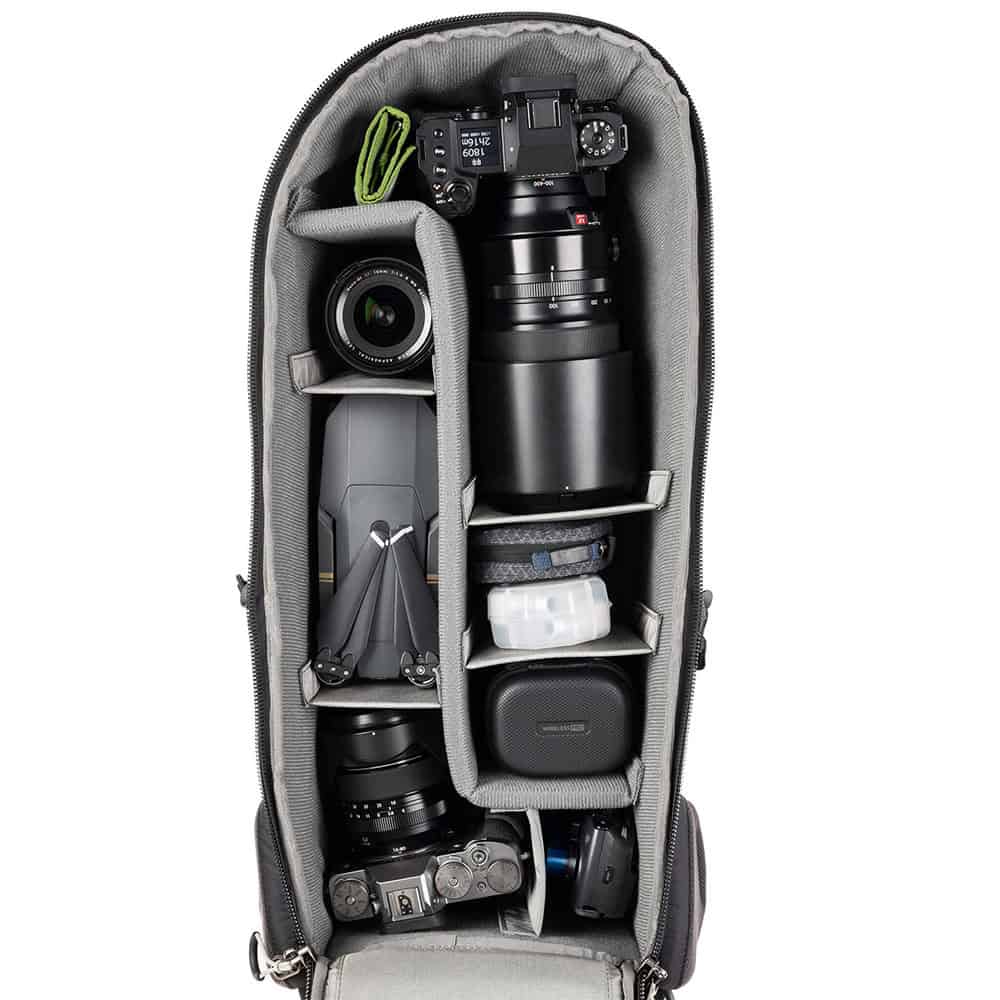
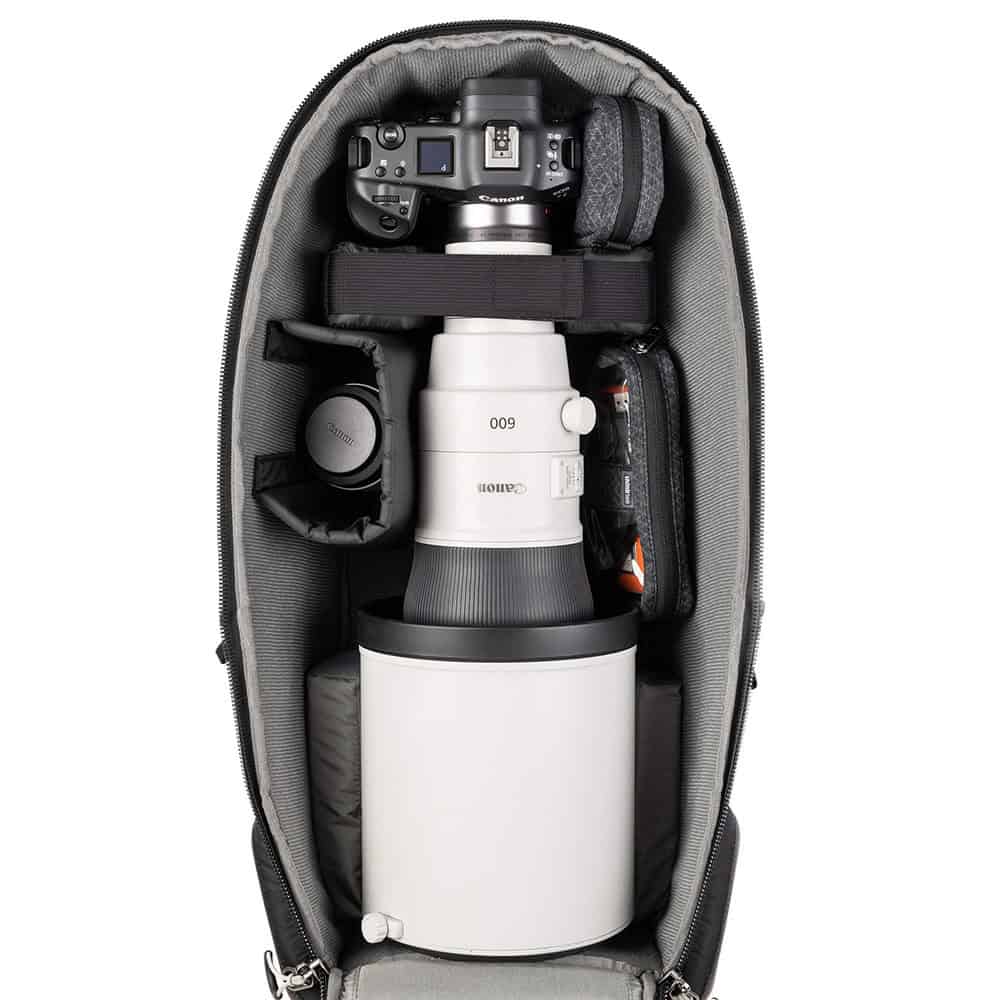
Reading Think Tank’s official guidance on what fits, they say:
- 800mm f/5.6 with gripped body attached plus adapter or teleconverter
- 600mm f/4.0 with gripped body attached plus adapter or teleconverter
- 400mm f/4.0 with gripped body attached plus adapter and teleconverter
- 300mm f/2.8 with gripped body attached plus adapter and teleconverter
- Alternatively, it carries a large kit consisting of two gripped bodies attached to lenses, plus room for an additional 2-6 lenses and/or accessories
This list is a starting point, but drawing on my experience with these types of lenses and my extensive collection of telephoto lenses in my gear cupboard, we can expand it and make it more relevant to a broader audience. With that in mind, here are some other items that fit, purely in terms of a lens’s maximum length and not including other camera bodies or lenses you can stuff alongside the main long lens (more on that later).
Note: “with hood” or “+ hood” means the lens hood is installed in the forward-facing, ready-to-shoot position.
Telephoto Zoom Lenses
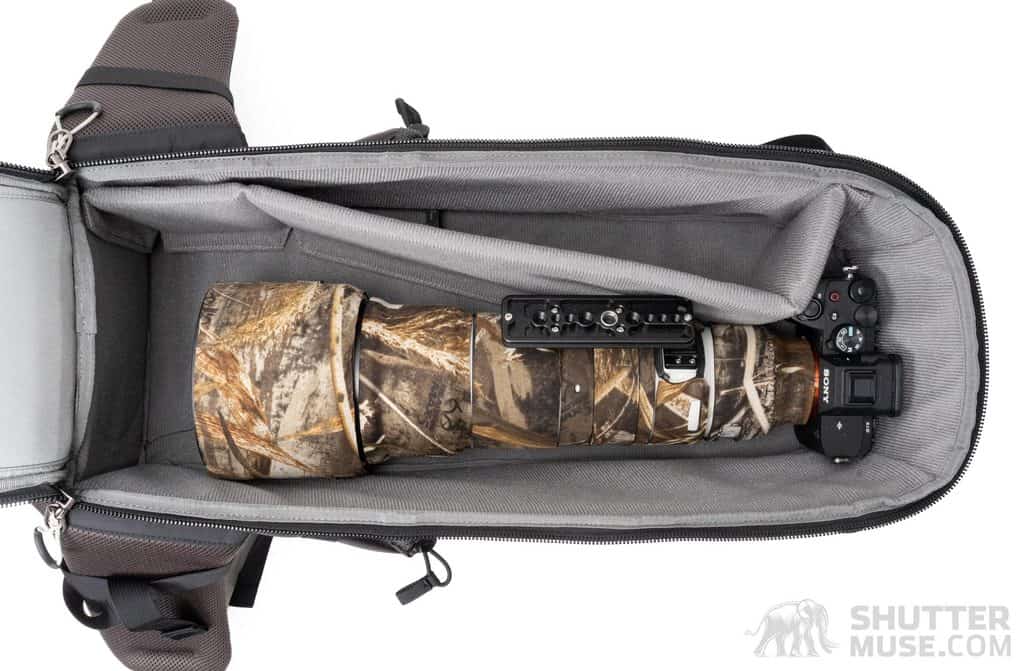
Gone are the days when wildlife photographers needed to use telephoto prime lenses that cost as much as a small car. Those lenses still have their place, but the availability of more affordable telephoto zoom lenses that deliver incredible image quality has opened this genre of photography to a broader audience.
For this reason, I wanted to closely examine how the current popular telephoto zoom models fit in the BackLight Long Lens backpack. Far more people use these lenses than telephoto primes, and Think Tank’s compatibility list completely ignored this category. Here is what fits:
- Sony 100-400mm f/4.5 GM with hood + attached camera + any teleconverter
- Sony 200-600mm f/4.5-6.3 G with hood + attached camera + any teleconverter
- Sony 400-800mm f/6.3-8 G with hood + attached camera + any teleconverter
- Nikon Z 180-600mm f/4.5-6.3 with hood + attached camera + any teleconverter
- Canon RF 100-500mm f/4.5-7.1 L with hood + attached camera + any teleconverter
- Canon RF 200-800mm f/6.3-9 with hood + attached camera + any teleconverter
This is great news for many of you. All of these modern mirrorless telephoto zoom lenses will comfortably fit in the Think Tank BackLight Long Lens backpack, with the hood in the forward-facing shooting position, an attached camera body, and even an attached teleconverter.
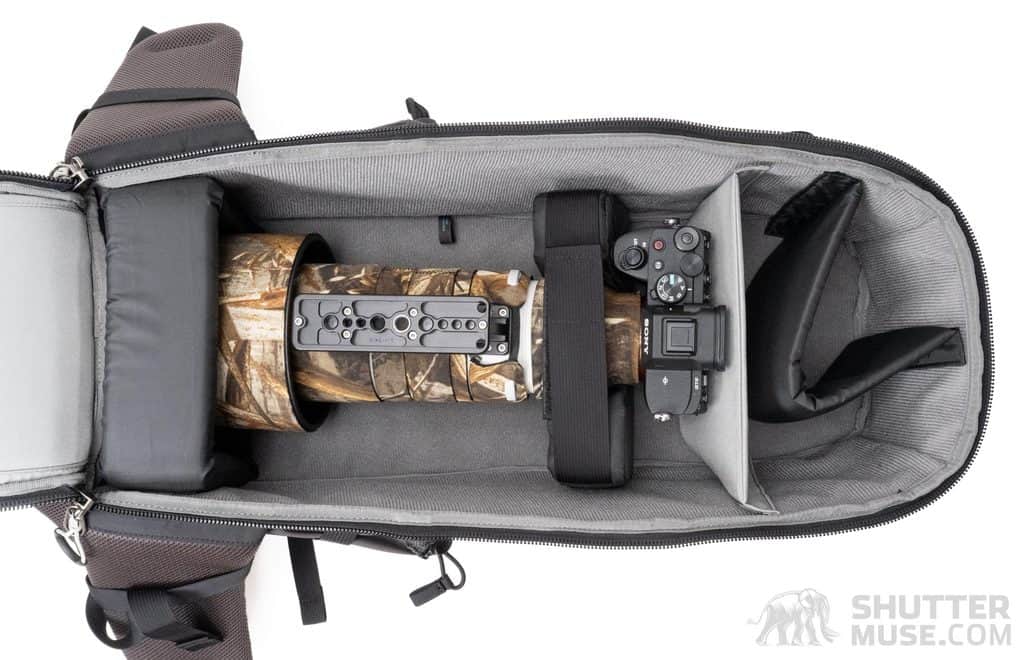
What’s potentially even more interesting for users of these telephoto zooms is the option to use the bag’s central divider diagonally in the main compartment to create protected spaces for two telephoto lenses. The following list isn’t exhaustive, but combined with some of my example loadout images, it should give you a good idea of how to carry a multi-telephoto setup.
- Sony 100-400mm f/4.5 GM + Sony 400-800mm f/6.3-8 G – both with attached cameras.
- Sony 300mm f/2.8 GM + Sony 70-200mm f/2.8 GM II – both with hoods, attached cameras, and teleconverters.
- Sony 300mm f/2.8 GM + Sony 400-800mm f/6.3-8 G – both with attached cameras and teleconverters.
- Nikon Z 400mm f/4.5 + Nikon Z 600mm f/6.3 – both with attached cameras.
- Nikon Z 100-400mm f/4.5-5.6 VR S + Z 600mm f/6.3 VR S – both with attached cameras.
- Canon RF 70-200mm f/2.8 + Canon RF 200-800mm – both with attached cameras.
The bag’s width doesn’t allow for carrying multiple large telephoto prime lenses side by side, which the larger FirstLight backpack + can accommodate. However, the ability to carry multiple zooms, along with some smaller primes, is extremely welcome. A wildlife photographer’s constant quandary, when capacity is limited, is whether to carry a large prime, which offers great light-gathering potential but limited framing flexibility. Or whether to carry smaller-aperture zooms that offer focal-length options, usually at the cost of higher ISOs. Whatever your choice, the BackLight Long Lens can meet your needs.
300mm Lenses
- Sony 300mm f/2.8 GM with hood + attached camera (or any other 300mm f/2.8)
- Canon RF 100-300mm f/2.8 with hood + attached camera
- Nikon Z 120-300mm f/2.8 TC VR S with hood + attached camera
All of these lenses can be stored with attached lens hoods for quick extraction and setup. There’s also room to leave 1.4x or 2x teleconverters attached. Even in these longest configurations, there’s still a little extra room at the top of the bag for extra lenses or a second camera body.
400mm Lenses
- All 400mm f/2.8 lenses with attached camera and any teleconverter in place.
- Sony 400mm f/2.8 GM + hood + attached camera – This is a snug fit.
- Nikon Z 400mm f/4.5 VR S + hood + attached camera + any teleconverter
If you really want to leave the lens hood in the forward-facing position with your 400mm f/2.8, I suggest using a shorter third-party Zemlin lens hood. With one of those, this setup is possible with all setups.
600mm Lenses
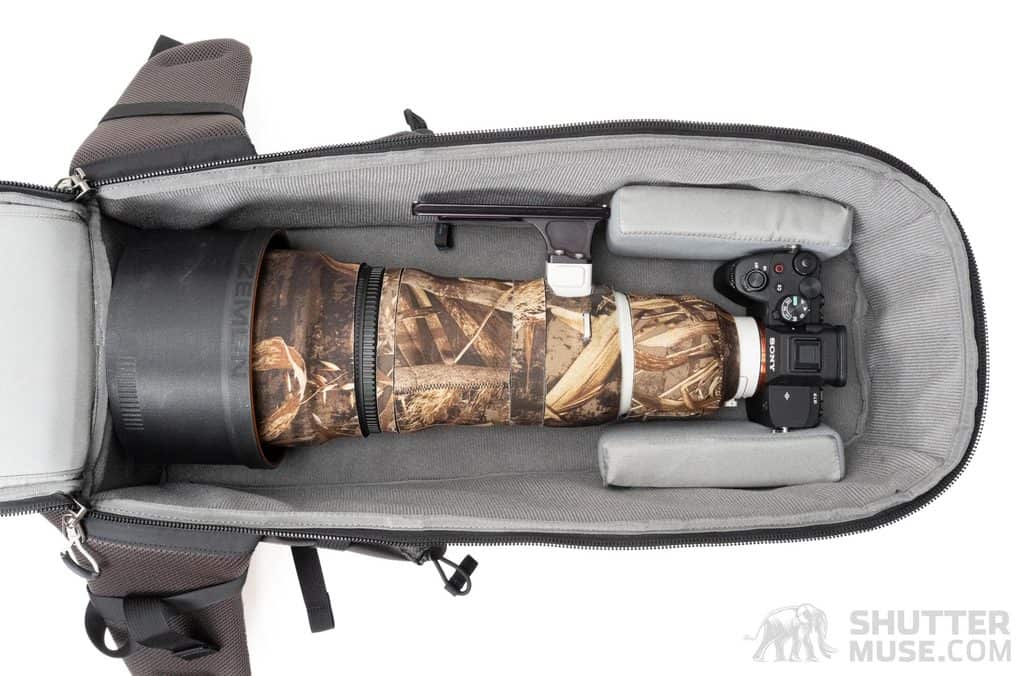
- All 600mm f/4 lenses with attached camera.
- Canon EF 600mm f/4 + EF/RF adapter + attached camera (snug fit).
- Canon RF 600mm f/4 + 1.4x TC + attached camera (snug fit)
- Sony 600mm f/4 GM + attached camera + any teleconverter.
- Nikon Z 600mm f/6.3 VR S + hood + attached camera + any teleconverter.
- Sigma 300-600mm f/4 + attached camera.
Of note in this section: while the BackLight Long lens is tall enough to accommodate all major 600mm f/4 lenses and the Sigma 300-600mm f/4 with an attached camera body, you can only comfortably fit a 2x teleconverter with the Sony model. This is less of an issue with the Nikon Z 600mm f/4, as it has a built-in 1.4x teleconverter anyway, so Canon shooters using Canon’s MKI RF 600mm and Sigma 300-600 users need to keep this in mind.
There is plenty of space to remove and store an additional 2x teleconverters separately, but this might not be ideal if you constantly shoot with it attached. Alternatively, you could leave the teleconverters attached and remove the camera, storing it alongside the lens with the included camera padding. This is arguably easier, as the task involves fewer steps: remove camera -> attach lens rear cover -> attach camera front cover. Instead of: Remove camera -> remove teleconverter -> attach TC front cover -> attach TC rear cover -> reattach camera.
800mm Lenses
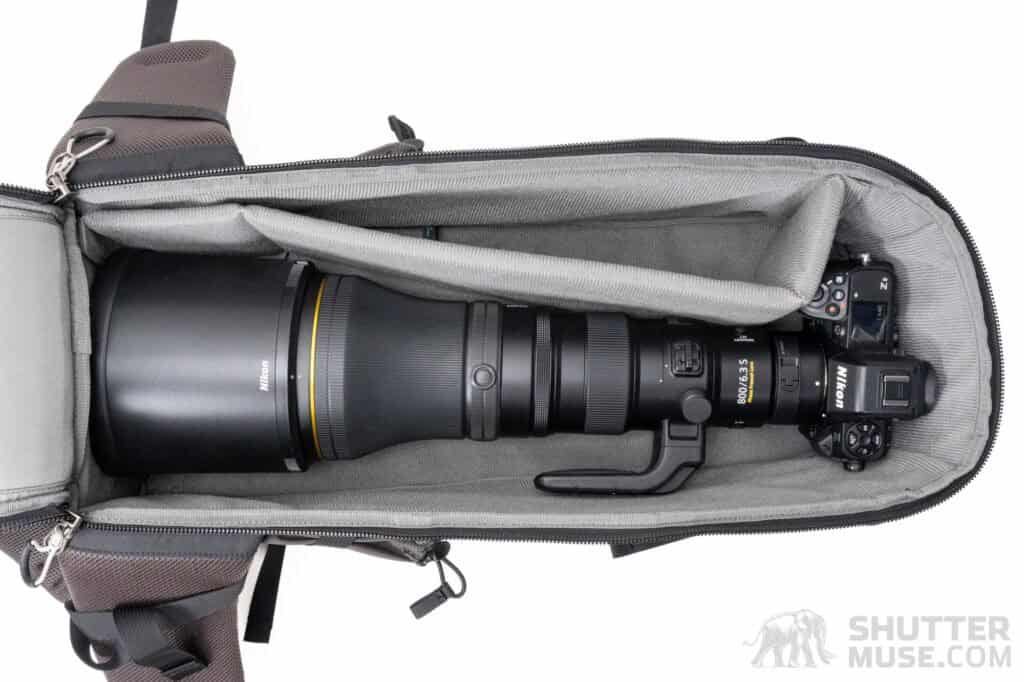
- All 800mm f/5.6 lenses with attached camera.
- Canon RF 800mm f/5.6 L with attached camera + teleconverter
- Nikon Z 800mm f/6.3 VR S with Zemlin hood + attached camera + teleconverter
- Nikon Z 800mm f/6.3 VR S with Nikon hood+ attached camera (snug)
Of note in this section: Canon’s RF 800mm f/5.6 is significantly shorter than the old EF 800mm f/5.6, meaning you can also leave a teleconverter attached during storage. However, none of the 800mm f/5.6 lenses on the market are short enough to leave a first-party hood attached while storing the camera with a teleconverter. The Nikon Z 800mm f/6.3 is different. Its more compact design allows you to either leave a Zemlin hood attached and store the camera with a teleconverter attached, or, if you don’t need ot store it with an attached teleconverter, and the bag will hold the lens with an attached camera and the original Nikon lens in the forward position.
BackLight Long Lens Design and Features
In this section, I’ll detail and discuss each of the bag’s features. Remember that you can click the images to open larger versions.
Top Handle
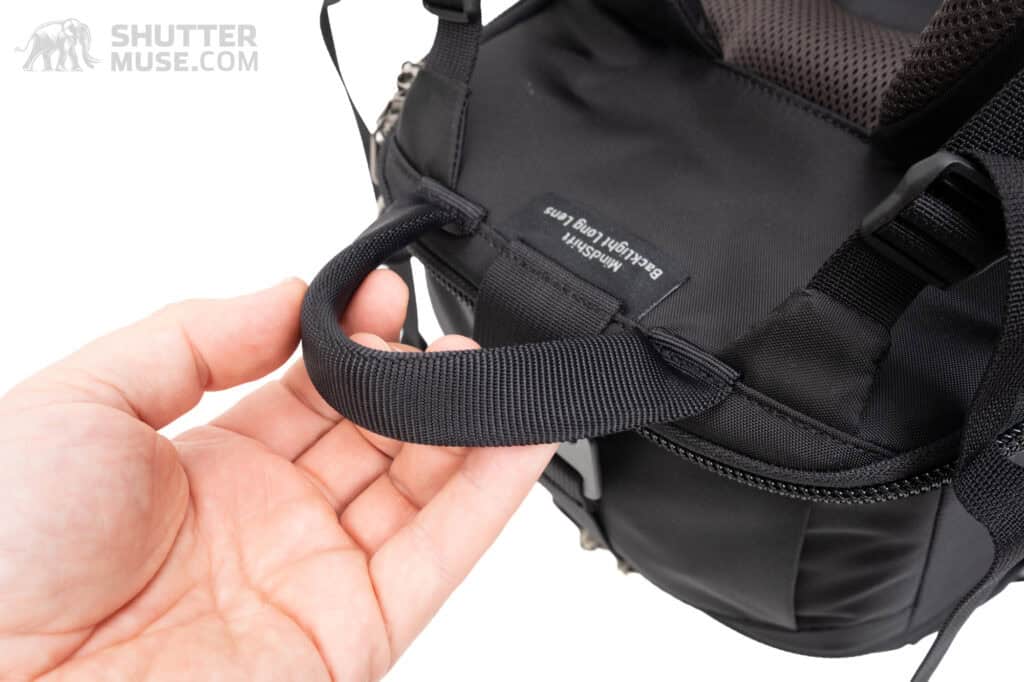
The backpack includes a lightly padded top handle for moving it short distances, or, I guess, hanging it on a hook, if that’s how you organize your gear at home. Though hardly an exciting feature, I’d be disappointed if it didn’t have one, as I find it very useful.
Camera Access
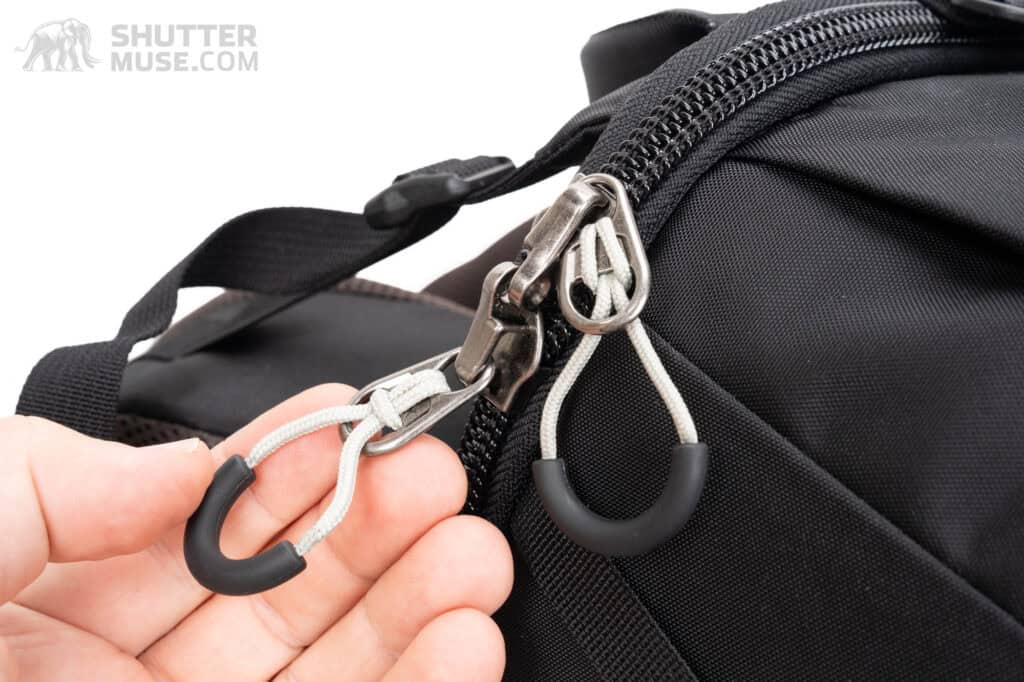
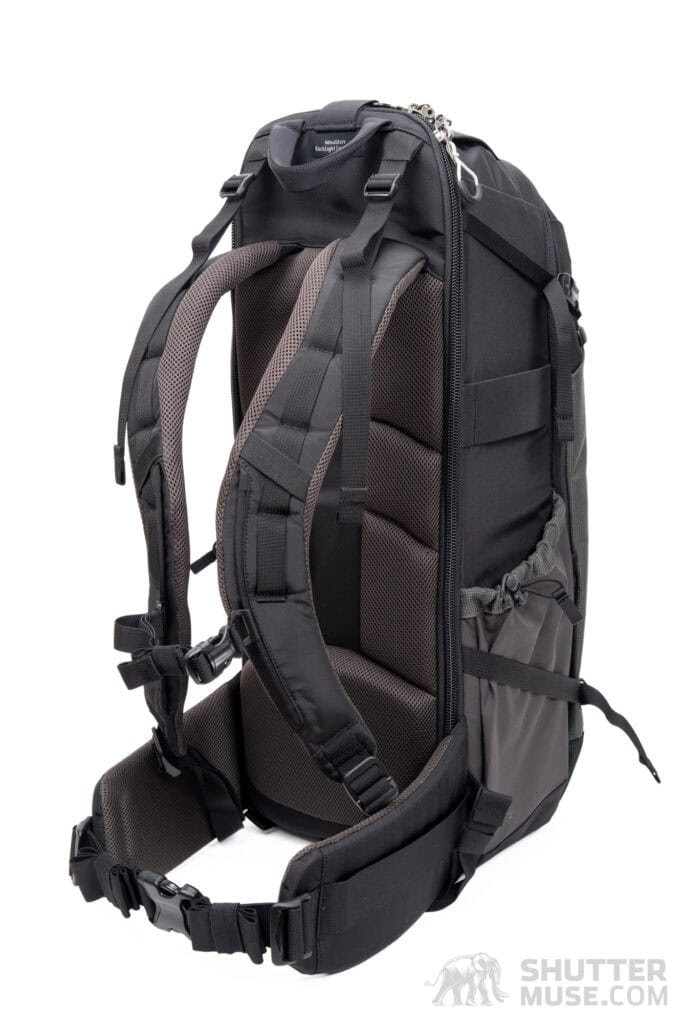
As with all bags in the BackLight series, camera access is through a zippered back panel. A large-gauge, lockable YKK zipper handles this main duty smoothly. The main benefit of a back panel access camera backpack is that you can lay the bag on its front to open the rear panel. This leaves you the option of keeping the harness and back panel padding off the ground by either holding it up with one hand or opening it towards your body, resting it on a knee, if you need both hands to extract the camera.
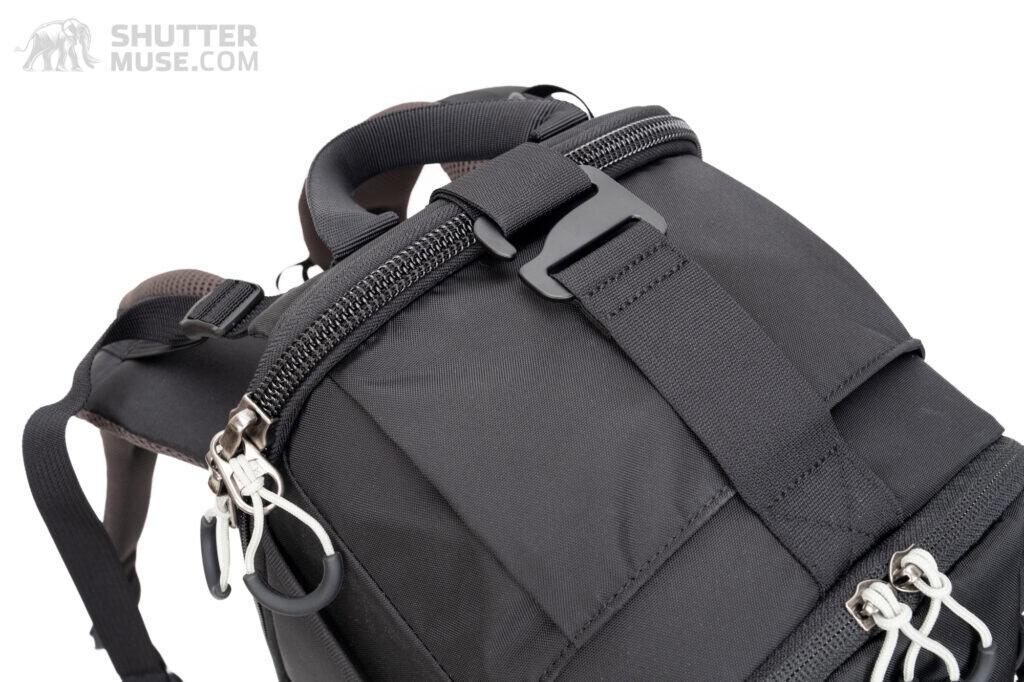
Another feature of the backpack’s rear opening system is a large aluminum hook. This hook is a security feature that prevents the back panel from opening when you lift the bag by the previously described top handle. Since the handle is stitched to the top of the rear panel, if you accidentally fail to fully close both zippers, the weight of a heavy super telephoto lens could cause the zippers to open quickly and dump out the bag’s contents.
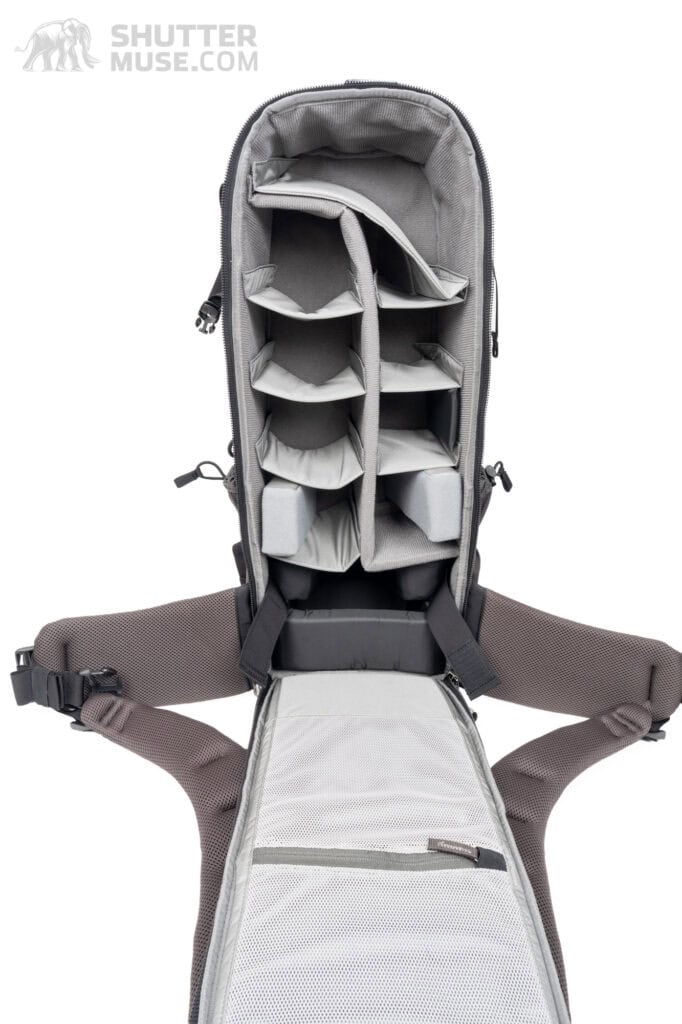
Once the back panel is open, you have clear access to your cameras and lenses. Of note, the shoulder straps are attached to the back panel, not the main body of the bag. This isn’t always the case with back-panel-access camera bags. Sometimes the shoulder straps are attached at the top of the bag (as with the rest of the BackLight lineup), requiring them to be folded out of the way when accessing your gear. This isn’t generally a problem for most people extracting smaller lenses, but it can be an issue with big super telephoto setups. The minor downside of this configuration is that the shoulder straps may dangle onto the ground when you open it, unless you pay attention and support them.
Specialized Padding
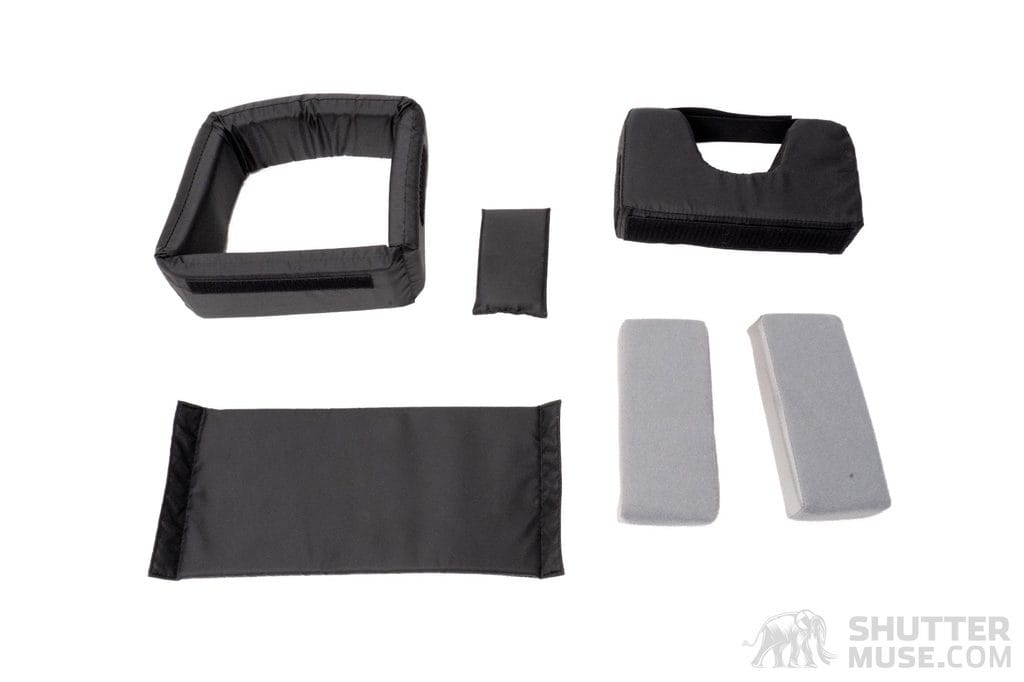
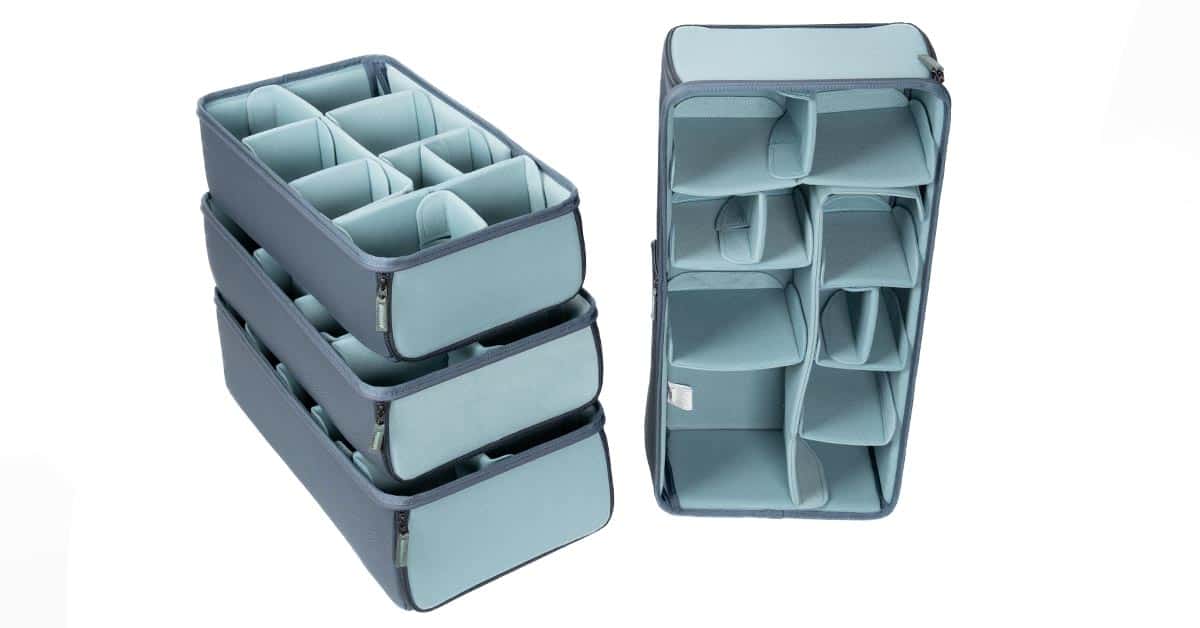
Included camera bag padding doesn’t usually warrant its own feature sub-heading, but this bag’s niche use means it comes with a few non-standard-looking accessories. The first is a big black padded donut, designed to sit in the bottom of the bag to stabilize the front of telephoto lenses with smaller lens hoods. It’s a good fit for things like a 300mm f/2.8 or an 800mm f/6.3. I have also used it with my smaller telephoto zooms like the Sony 100-400mm f/4.5 GM or 400-800mm G lens. Their lens hoods do leave a little space in the donut, but it’s still better than not using it.
The second item of note is a large U-shaped piece of padding designed to cradle larger super telephoto lenses n near the mount. Whether you find this necessary largely depends on how tight the padding is around your camera once everything is set up. If there’s no wiggle room for your attached camera, I generally don’t find a padded collar necessary. That said, if you are carrying multiple lenses, it can be useful to secure the largest lens in place while your camera is out of the bag attached to your second, smaller lens.
Next up is a pair of rectangular padded pads. These are multi-purpose and can be used pretty much anywhere to stop heavy lenses wiggling around while you walk. They work very nicely to create a cradle around the lens hood of a 600mm f/4. The fourth and final odd-looking piece of custom padding is the large black rectangular piece. It isn’t as rigid as some of the standard dividers and is included (and sized) specifically for creating a padded camera compartment alongside a super telephoto lens.
Hatch Organizer Pockets
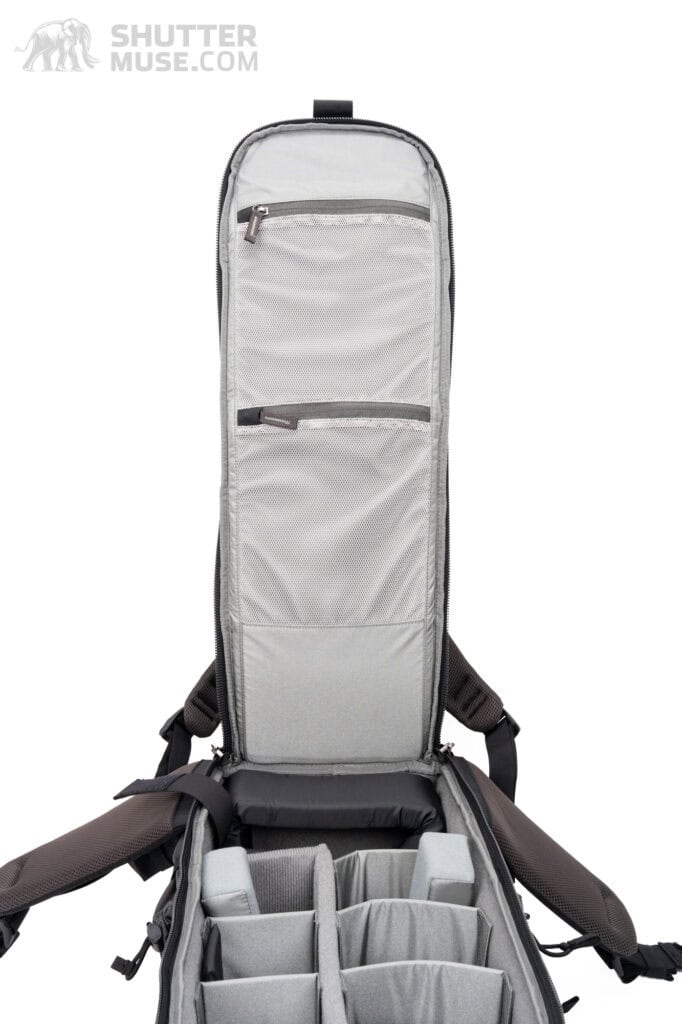
Think Tank offers a decent amount of small-item organization in the BackLight Long Lens, starting with a pair of zippered mesh pockets on the inside of the rear hatch. These pockets aren’t gusseted, but the mesh has enough stretch that non-flat items, such as camera batteries, will fit just fine. However, the lack of protection between those items and the cameras and lenses in the main compartment is something to consider. I prefer to use these pockets for lens cloths and a small packable towel that I carry to dry out gear after a deluge.
Front Pocket
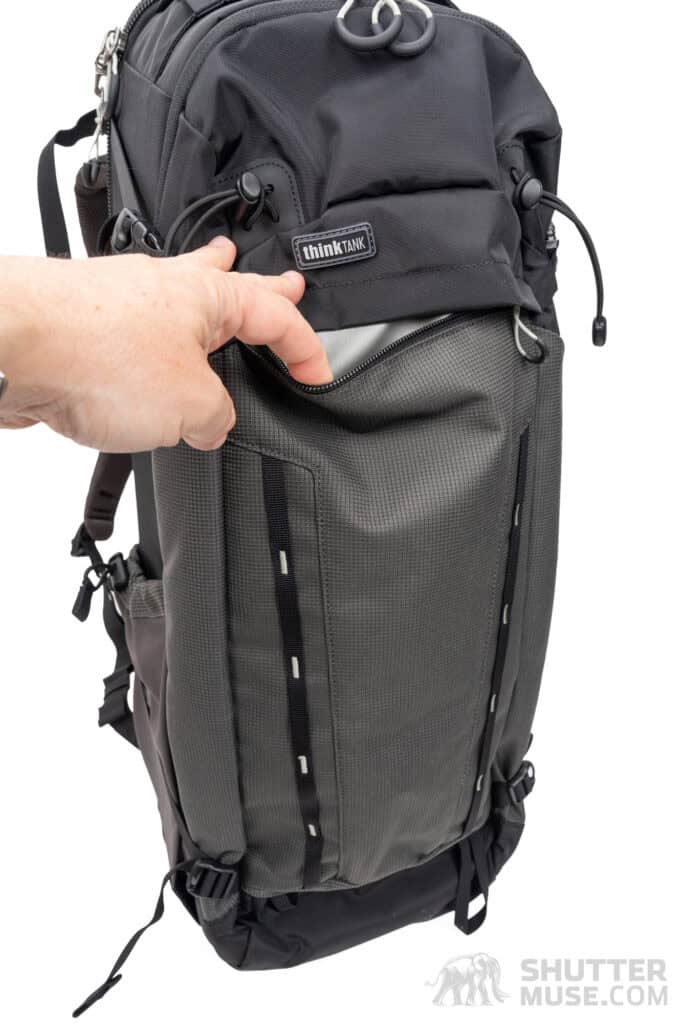
The backpack features two zippered front pockets. We’ll start with the frontmost. This pocket has a relatively flat profile, so you can’t fit really chunky items in it. The zipper opening also isn’t as wide as the pocket, so access feels constrained, and rooting around for small items at the bottom of the bag isn’t ideal. There’s really no way to see what’s in there. Still, this works well as a place to store the bag’s rain cover, and it’s also a great spot for a lightweight, packable rain jacket or pants. Just don’t use it for items you need on a regular basis.
Front Organizer Pocket
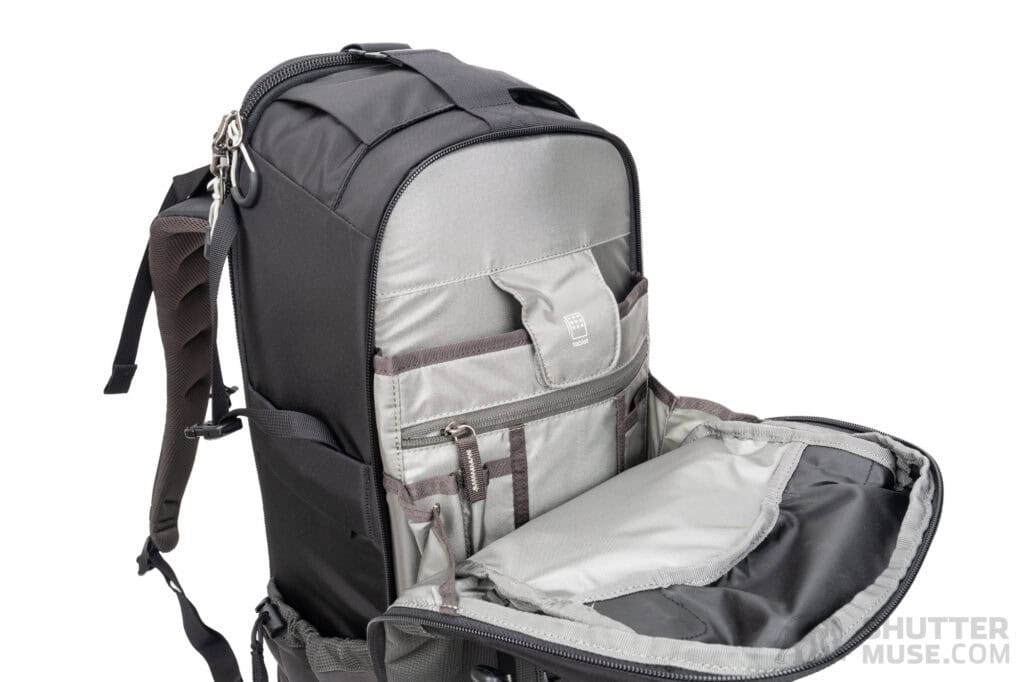
The second front pocket is entirely different from the first, offering a generous 7L of space, a wide opening, a padded tablet pocket, several smaller organizer slots, and an interior zippered pocket. The main section of this front pocket is large enough to hold a compressed down jacket or accessories such as hotshoe flashes and flash brackets for macro work. I don’t usually carry a tablet, but I often have a wildlife field guide for my current location, and the tablet pocket works perfectly for it.
I expected to find a key clip in the smaller zippered pocket to attach a memory card wallet, but it’s missing. It’s useful to have such a large storage space for non-photographic items, but to open the zipper and pull down the flap, you must release the top compression strap on each side of the bag. If that strap is securing a side load, such as a tripod, the process feels convoluted, and I found myself avoiding the pocket for frequently accessed items. The exception was my field guide in the tablet pocket, which I found accessible without fully opening the pocket, so it didn’t require releasing the side straps. Finally, I found the zipper on this pocket rather stiff when pulled up with the bag standing on its base. It felt fine pulling it down to open it, but it felt overly abrasive and loud when pulling it up to close it. I’m not sure what’s going on there, but I expected it to feel smoother in a bag at this price point.
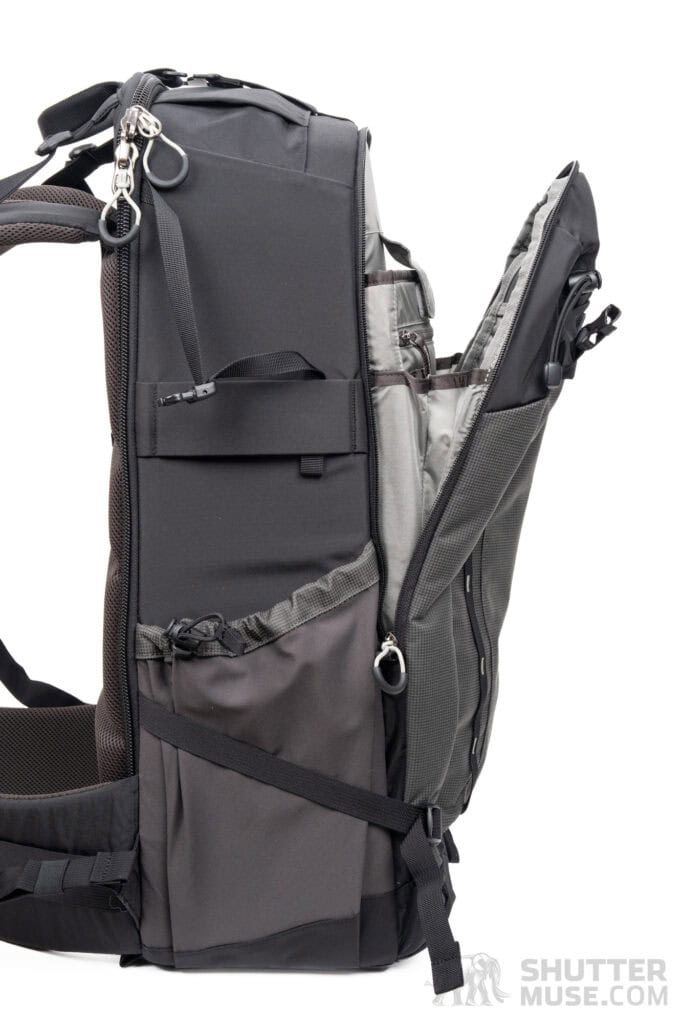
Modular Side Rails
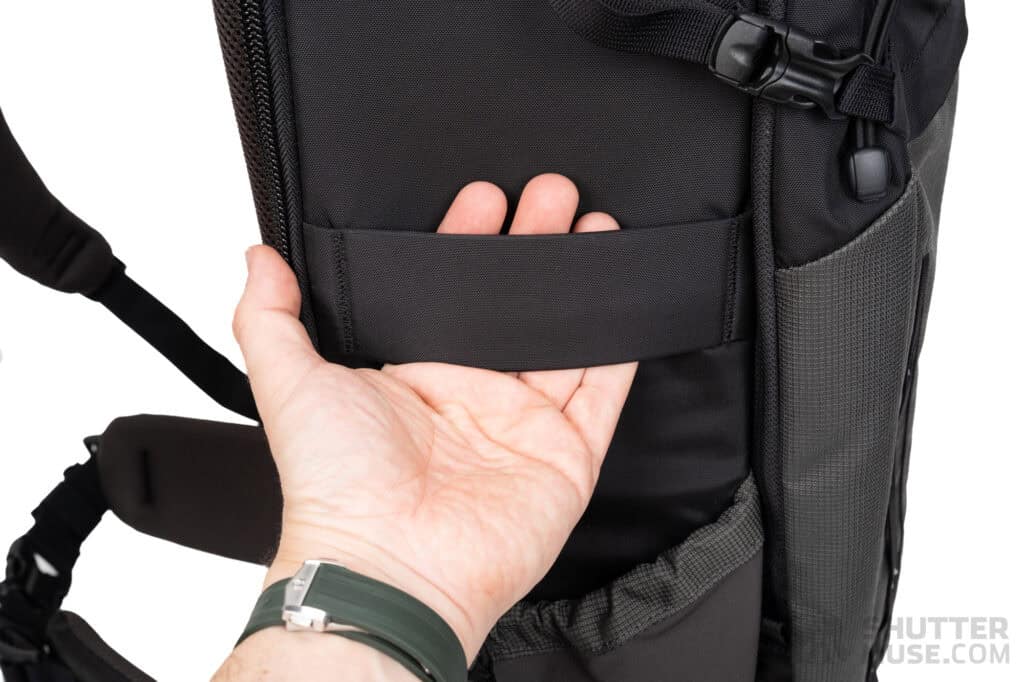
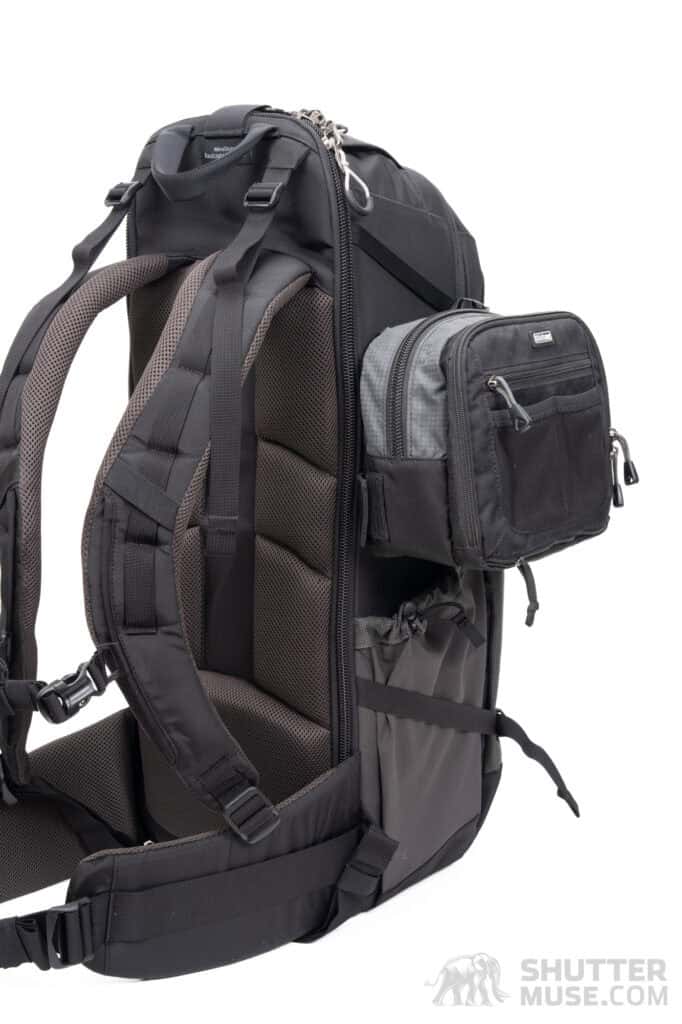
Both sides of the backpack feature sturdy rails for attaching Think Tank’s modular pouches or camera holsters. These can be useful for carrying anything from an extra camera body or a pair of binoculars to an entire zoom lens with another camera attached, like a 150-600mm or 200-600mm lens in the Digital Holster 150.
Harness
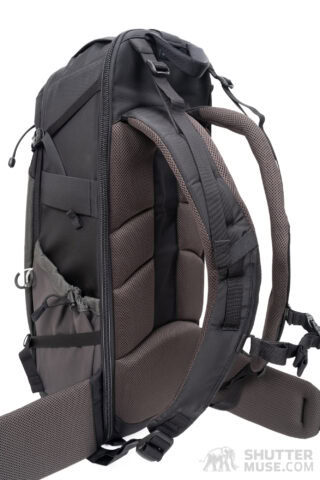
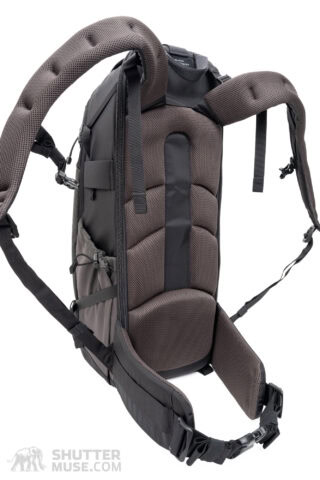
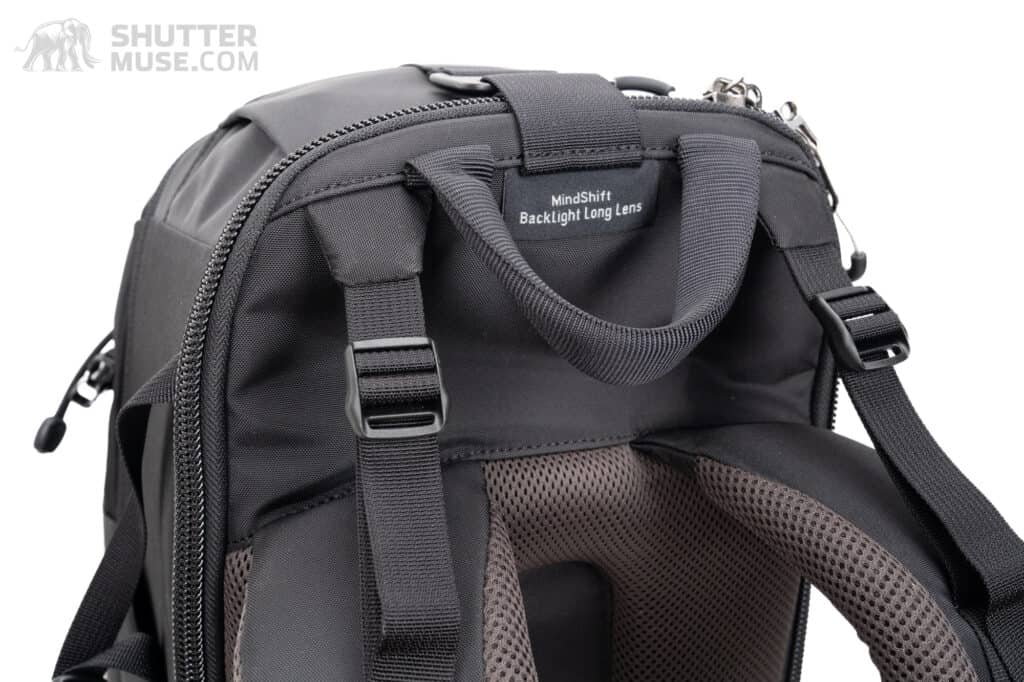
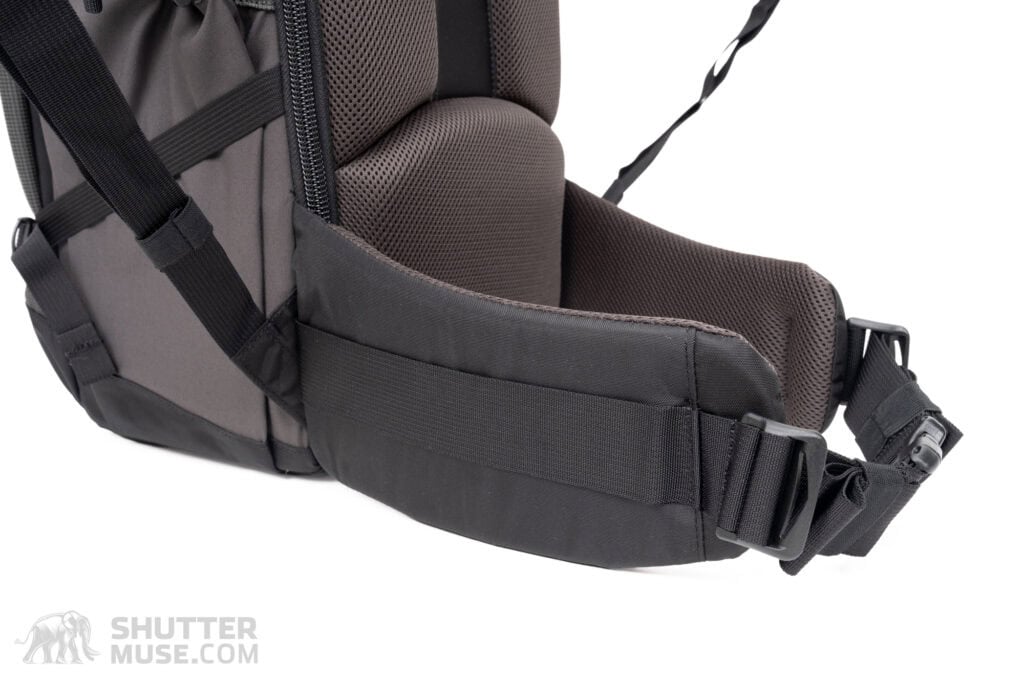
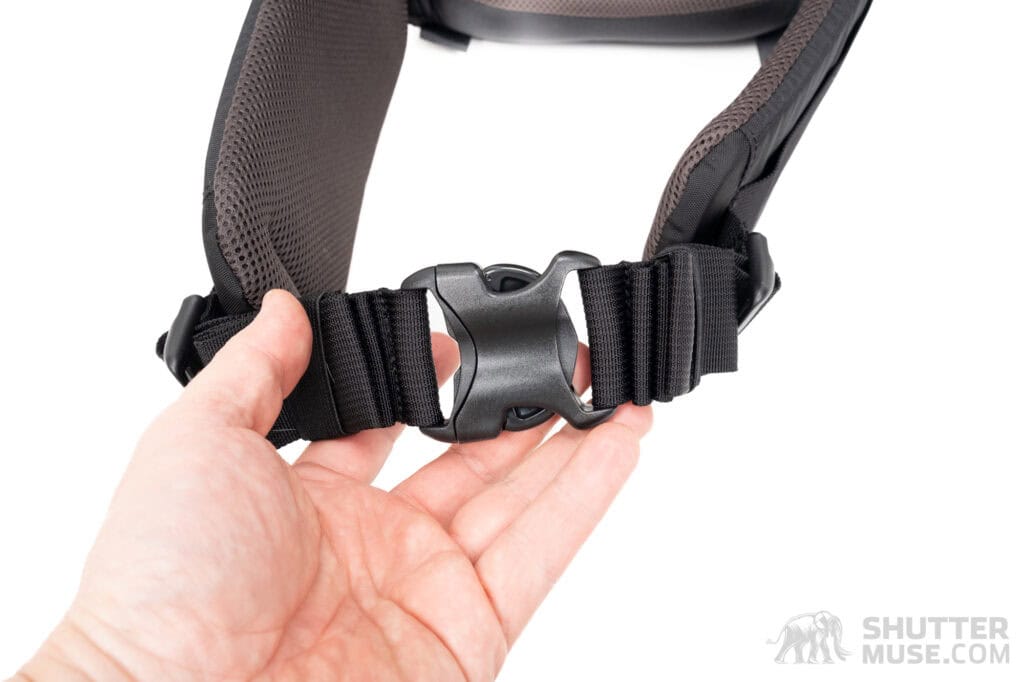
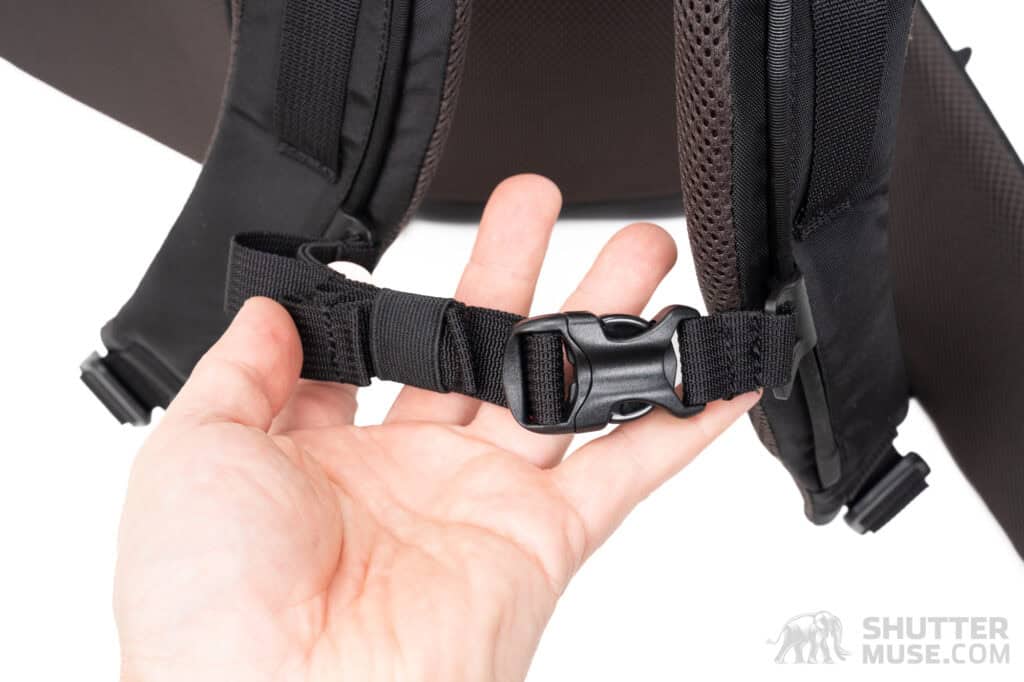
Hydration Compatibility
For camera bags designed for, or at least capable of, longer hiking missions, the question of hydration always comes up. Over the 20+ years I have been reviewing camera bags, many people’s preferences seem to have shifted. It used to be that 1-2L Platypus-style water bladders with their long drinking hoses were the preferred way to carry water on longer hikes. These days, most people, myself included, seem to prefer the simplicity of a 500ml-1L water bottle. They are easier to refill, far easier to clean, and, from a photographer’s standpoint, far less likely to leak internally.
With this in mind, all I really need now is a large enough side pocket on a backpack to carry a 1L Nalgene bottle. If a backpack can carry that, it’ll also carry skinnier-but-taller bottles from other brands. The BackLight Long Lens bag has a large elasticated pocket on either side of the bag, capable of holding a large water bottle. An elastic cinch cord on the pocket helps stabilize and secure skinnier bottles.
Tripod Carry
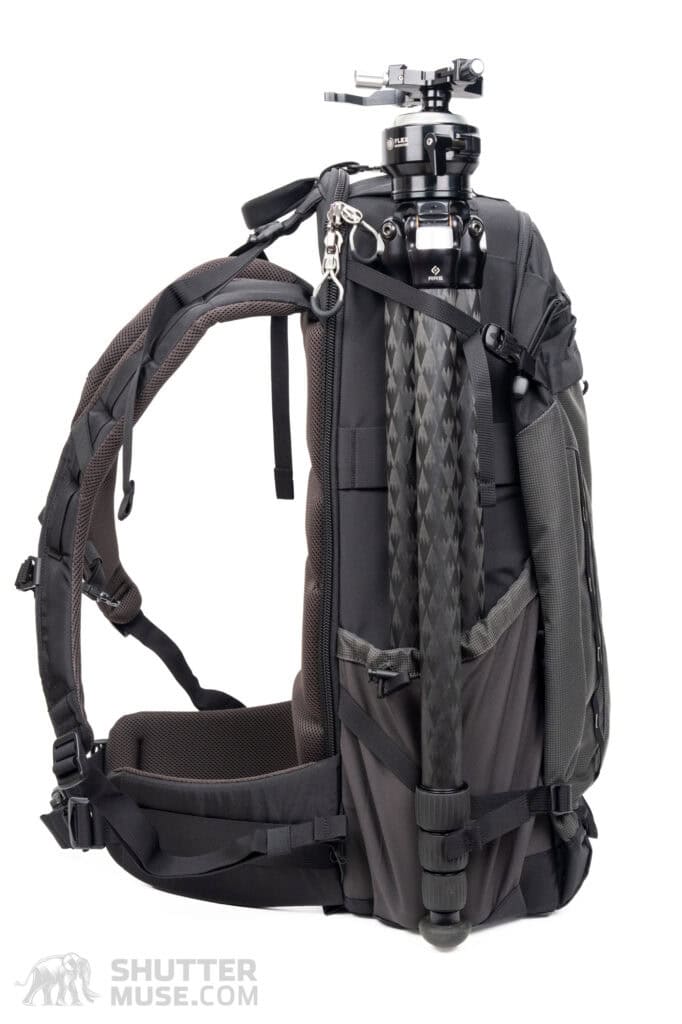
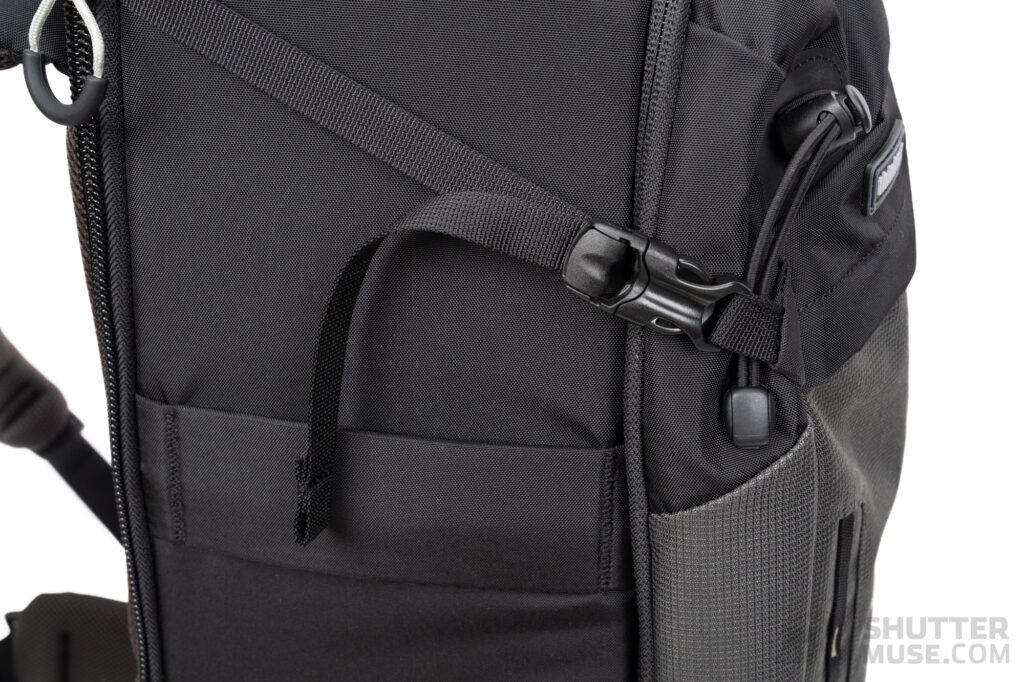
The BackLight Long Lens offers the same tried-and-tested tripod-carrying format found on most Think Tank camera bags. There are two ways to carry your tripod (or monopod): First, you can mount the tripod on the side of the bag by placing two of the feet in the side pocket and securing the top of the tripod with a nylon webbing strap. The buckle on this side strap has a locking mechanism that prevents it from sliding down the webbing, so you don’t have to constantly readjust and tighten the strap every time you undo it. The second tripod-carrying option is to use the concealed tripod cup and top-attachment strap to mount it on the front of the bag.
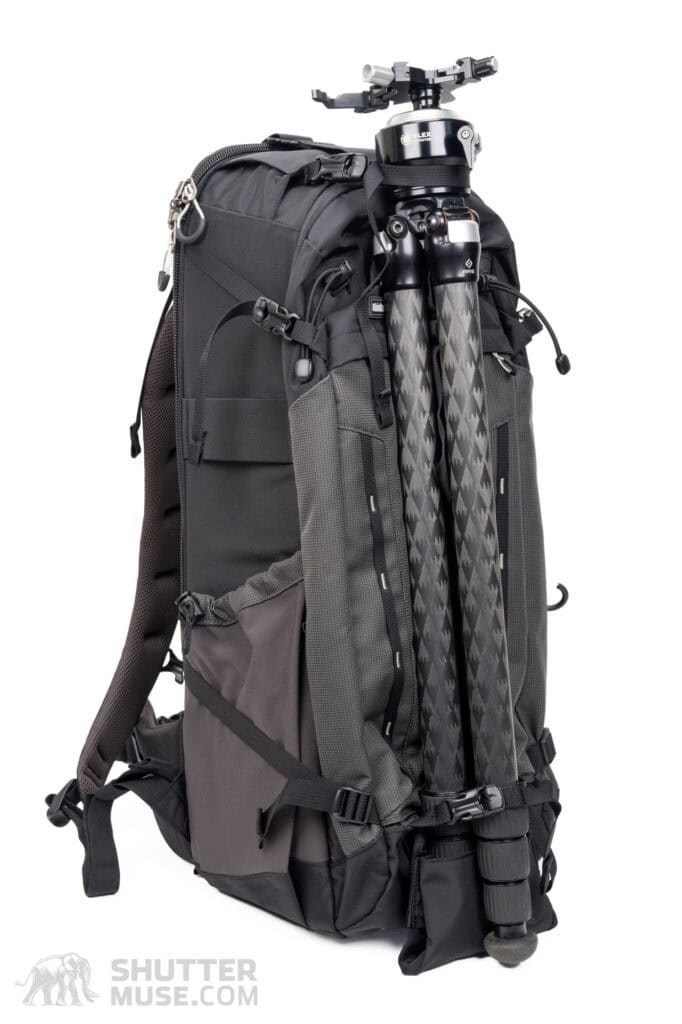
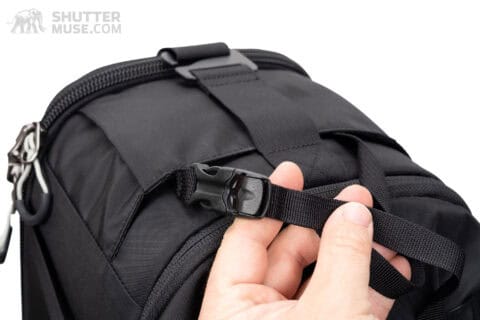
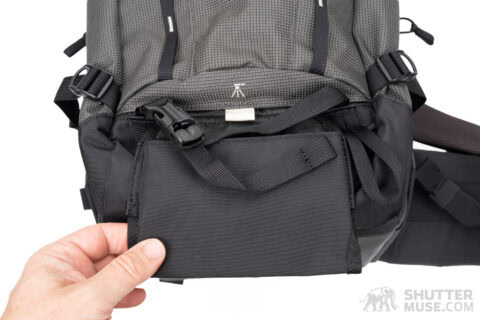
Both options have pros and cons. Side-mounting a shorter, lighter tripod or monopod works really well. If you have a gimbal head attached, make sure you secure it so that it points away from the back of your head. Speaking from experience! Heavier tripods can unbalance you to one side if you choose the side-mounting option, and taller tripods might still bump the back of your head while you hike, even with careful head placement. The other downside of the side-mount option is that the securing strap passes over the zipper of the bag’s front pocket. The tripod strap must be unbuckled if you want clear access to the contents of that pocket.
The downside of the front-mounted tripod option is that with a tripod strapped to the front, you can’t lie the bag flat on the ground to unzip the camera compartment. For me, this is the big one, and it’s why I always opt to side-carry the tripod on any of Think Tank’s BackLight Series backpacks. In a fast-developing wildlife situation, I want to be able to set the bag on the ground and access my camera and lens as quickly as possible. That is the very ethos of a bag like this, which allows you to carry an attached camera with a long lens. I don’t want to worry about whether I’m laying the tripod on sand, mud, or rocks that might damage it. Your mileage may vary, but I’ll choose the side pocket for my tripod every time, and I’ll try to use smart packing to balance some of that lopsided weight wherever possible.
Exterior Gear Attachment
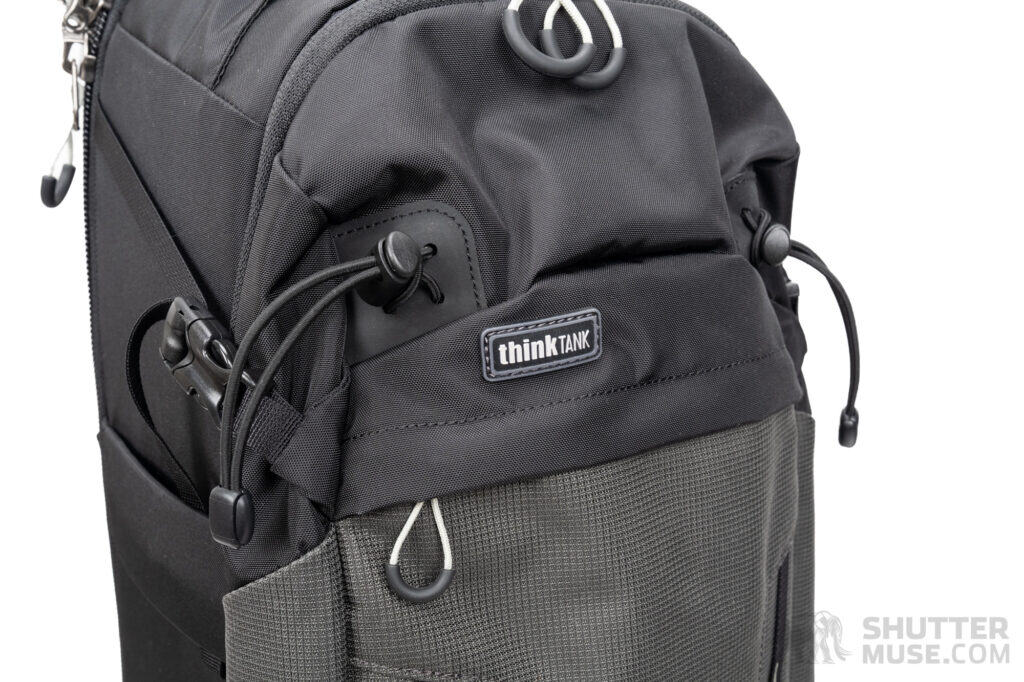
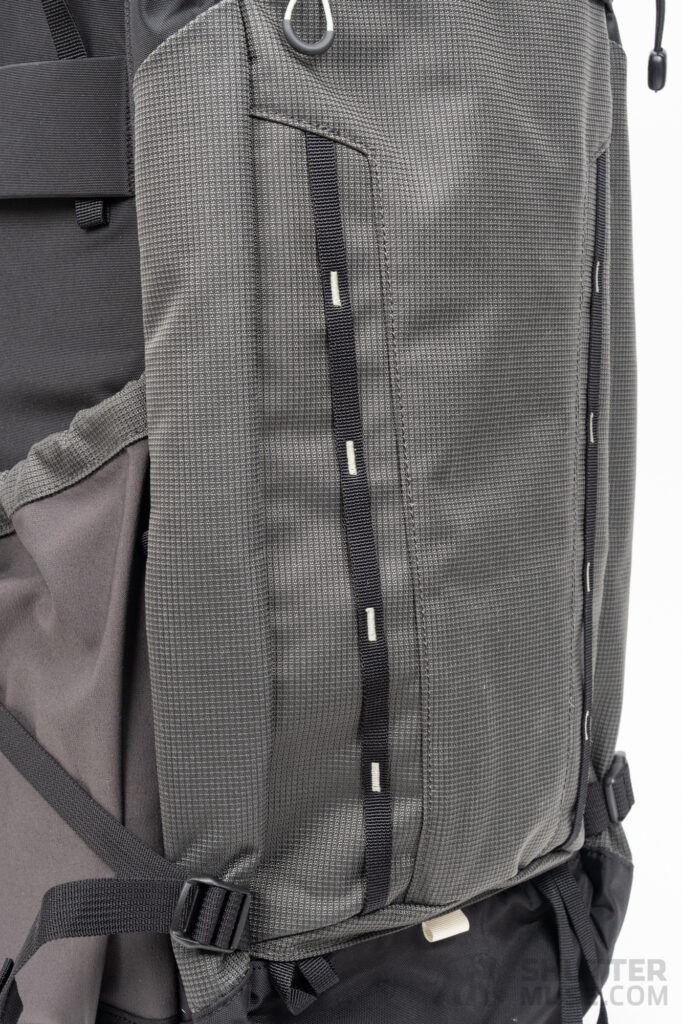
Aside from the standard photographic gear attachment options, Think Tank Photo’s designers have also included a pair of elasticated straps for attaching hiking pole handles, with complimentary nylon loops at the base of the bag for the pole ends. In addition to that, there are two daisy chain rails on the front of the bag, which can be used in conjunction with some carabiners to attach all manner of additional items.
Rain Cover
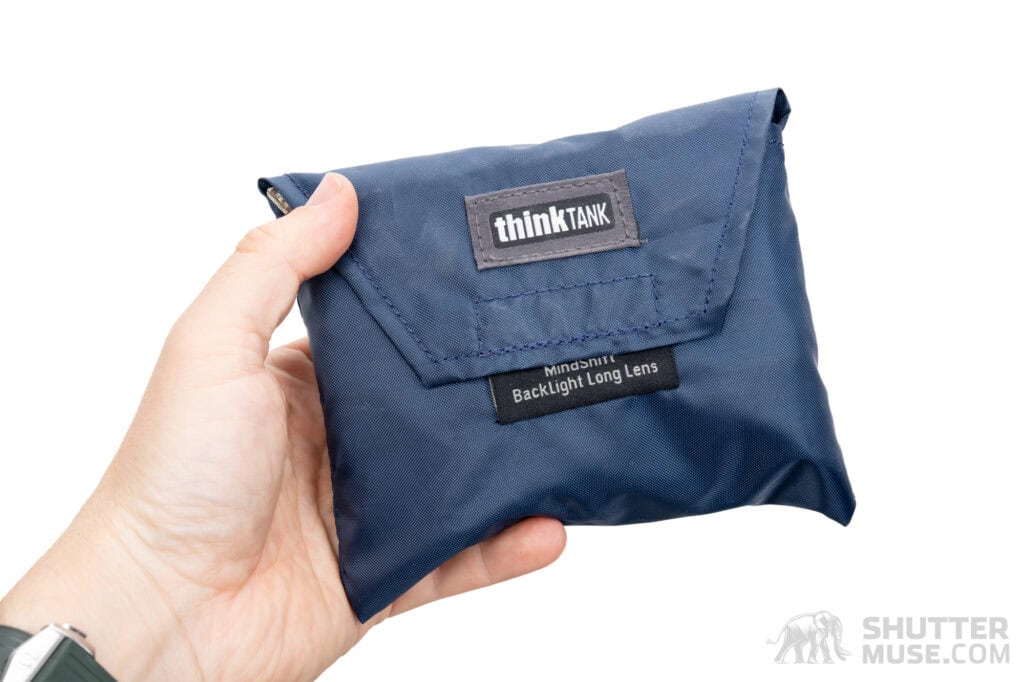
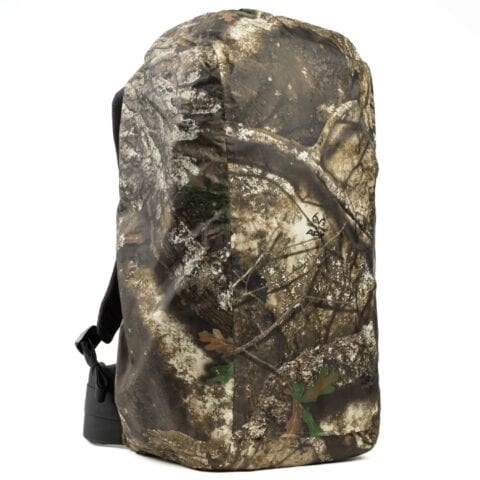
The BackLight Long Lens bag is Think Tank’s first camera bag to come with a Realtree camouflage rain cover. What’s nice about this is that the cover can double as protection from a downpour or simply help camouflage your presence while moving through the woods or waiting for wildlife. The backpack doesn’t have a dedicated rain cover pocket for storing the cover. Still, I found stuffing it into the deep front pocket put it out of sight and mind until I needed it. It’s a nice pairing with Think Tank’s camouflage Hydrophobia and Emergency rain covers.
Airline Carry-on Compatibility?
Most large camera backpacks designed for telephoto lenses top out at carrying an unmounted 600mm f/4 because that lens is very close to the average maximum height of carry-on luggage. If you create a backpack capable of carrying a camera mounted to a 600mm f/4, like the one in question, it won’t meet many, if any, carry-on size requirements. The bag’s 24.75″ height is certainly larger than the allowance on all the airlines I regularly use, which top out at 21.5″ on the long end.
Could you sneak it on? I suspect you could in many situations. Particularly if you hold status with an airline, as the gate agents more often turn a blind eye to who’s carrying what when those early zones are boarding. Do you want that anxiety while you wait to find out? I don’t. Especially when the contents are worth so much, and the alternatives are either gate-checking or carrying your unprotected gear by hand onto the plane.
For some people, this will definitely limit the bag’s potential, but if it were carry-on compliant, it wouldn’t be the same bag; it would be pretty much the BackLight 36L, so it still makes a lot of sense for Think Tank to have this in the lineup. If you really need it while you’re traveling, you could pack clothes in it and place it in a larger duffel with the rest of your personal items to take it to your destination.
Compared To Think Tank’s Other Long Lens Bags
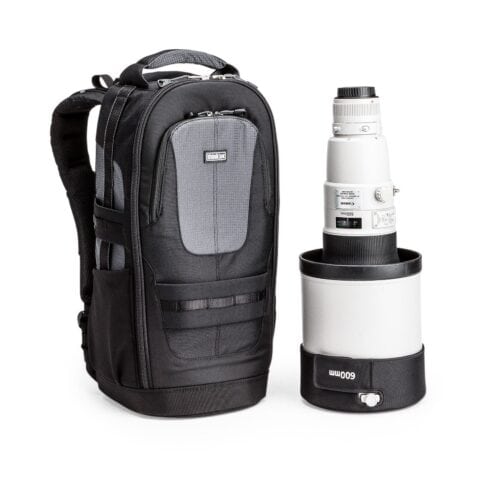
Think Tank has been making long lens camera bags for decades, and its current lineup includes another option called the Glass Limo. Though both bags are designed to carry super telephoto lenses, their intended use cases differ somewhat.
The BackLight Long Lens is designed with wildlife photographers in mind. It’s built to be carried into the field, offering a more comfortable carrying experience with its harness and outdoor-specific features such as the camouflage rain cover. When the Glass Limo was introduced way back in 2021, it was intended more as a companion bag to another bag, such as one of Think Tank’s esteemed rolling cases. Sports or event photographers who need to carry a 400mm f/2.8 or 600mm f/4 lens can use it to transport their largest lenses on airplanes, to the press room, or down to the sidelines.
The newer BackLight Long Lens backpack is taller, allowing you to carry a 600mm f/4 lens with a camera body attached. The Think Tank Glass Limo will carry a 600mm f/4, but not with an attached camera. The Glass Limo can accommodate a 400mm f/2.8 with an attached camera.
I don’t own the Glass Limo, but I did own its predecessor, the Glass Taxi. My current thinking is that even if your use case aligns with Think Tank’s intentions for the Glass Limo, you should still choose the newer BackLight Long Lens backpack unless you need a bag that meets airline carry-on regulations. The new BackLight Long Lens costs the same but offers more configuration options and considerably more volume in the 7-liter front pocket for non-photographic gear. Aesthetically, I think the new bag is also an improvement and aligns with Think Tank’s current design language.
| Spec / feature | Think Tank Glass Limo | Think Tank BackLight Long Lens |
|---|---|---|
| MSRP | $274.75 (check current) | $275.75 (check current) |
| Exterior dimensions | 9″ W × 21″ H × 9.2″ D / 22.9 × 53.33 × 23.4 cm | 9.5″ W × 24.75″ H × 8.5″ D / 24.1 × 62.9 × 21.6 cm |
| Interior dimensions | 8.7″ W × 19.5″ H × 8.3″ D / 22.1 × 49.5 × 21.1 cm | 8.5–8.25″ W × 22.75″ H × 6.5–8″ D / 21.6–21 × 57.8 × 16.5–20.3 cm |
| Weight | 3.9 lb / 1.8 kg, including accessories | 4.8 lb / 2.16 kg, including accessories |
| Listed volume | Not listed | 32 L |
| Tablet sleeve | None | Fits up to 13″ iPad Pro / similar tablet |
| Personal-gear capacity | Limited front organizer | 7 L front pockets for layers, food, accessories, etc. |
| Access style | Main/front-style long-lens backpack layout | Rear-panel access; designed to work out of the bag while upright or flat |
Conclusion
There’s a lot to like about the Think Tank Long Lens Backpack, and it’s one of the best solutions for carrying a telephoto zoom or super-telephoto prime lens attached to a camera. I wouldn’t choose it for airline travel due to its size, but for anything closer to home, it makes a ton of sense to store my larger lenses, like my 600mm f/4, in an easy-to-access, ready-to-shoot solution.
Think Tank’s products are generally well-built, and this pack is no exception. Thoughtful additions like the large metal safety hook show that they test their gear in the real world and solve real issues. I’m also a big fan of the custom padding and dividers that come with this pack. Many will use this bag with the big 400mm f/2.8s and 600mm f/4 lenses. Still, others will enjoy using it with smaller telephoto zooms, or small lightweight primes like a 600mm f/6.3, and the dividers give you great flexibility to repurpose the remaining space for more camera gear or general hiking necessities.
Where to Buy (Free Gift)
US Customers spending over $50 in Think Tank Photo’s online store can get a free gift at checkout after following one of the links to the store from this review–like this one. If you have any issues, please follow the instructions on this page.
As always, we appreciate you using our links for your purchases. Of course, US readers should shop directly with Think Tank to take advantage of the gift you get when spending over $50. Canadian readers should shop with B&H Photo as they offer free shipping and the option to pre-pay the tax and duties. This results in a better final price than buying from Think Tank distributors in Canada.
- Think Tank BackLight Long Lens – Think Tank (US only) / B&H Photo / Adorama / WEX (UK)
More camera backpacks in the BackLight range:
- Think Tank BackLight Sprint – Think Tank (US only) / B&H Photo / Amazon / WEX (UK)
- Think Tank BackLight 18 – Think Tank (US only) / B&H Photo / Amazon / Adorama / WEX (UK)
- Think Tank BackLight 26 – Think Tank (US only) / B&H Photo / Amazon / Adorama / WEX (UK)
- Think Tank BackLight 36 – Think Tank (US only) / B&H Photo / Amazon / Adorama / WEX (UK)
- Think Tank MindShift BackLight Elite 45L – Think Tank (US only) / B&H Photo / Amazon / Adorama / WEX (UK)