
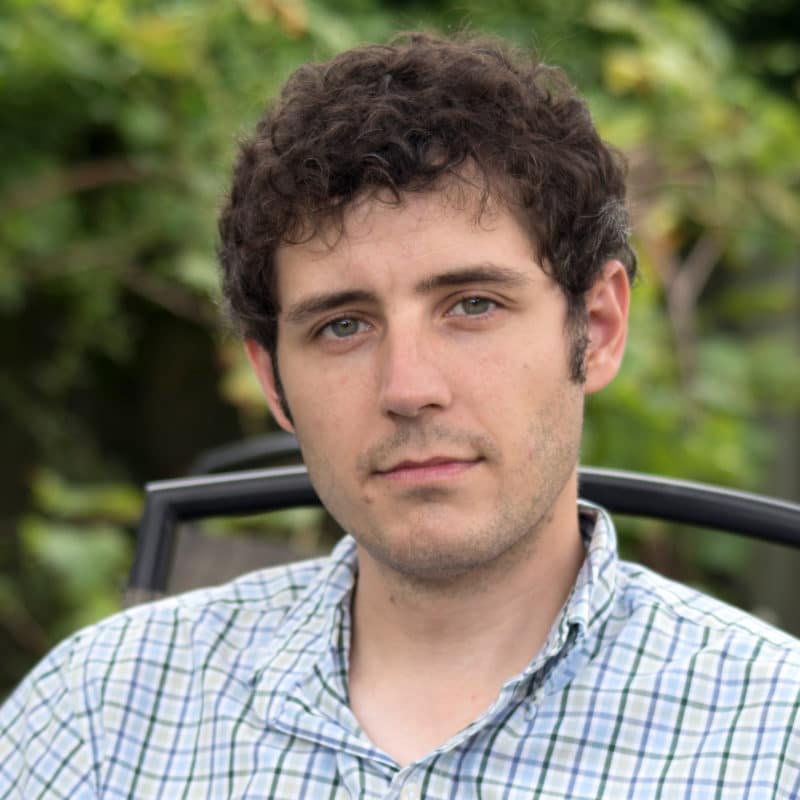
My next guest for this Shutter Muse interview series has made a big impact by really focusing on the little things. Don Komarechka has made a name for himself in the world of macro photography, exploring the realms of water droplet refraction, ultraviolet fluorescence and snowflakes.
He’s mastered his craft, landing international clients and a sold-out run of his first major book in the process. He’s unquestionably a camera gear junkie too and on his weekly podcast, Photo Geek Weekly, he discusses the latest industry technology and trends.
His images are so captivating, I just had to sit down and chat with him to learn about how he’s built a business around what he calls the “the universe at your feet”. Hold on for a wide-ranging discussion!

MJ: Thanks so much being up for this!
DK: No problem, thanks for inviting me.
MJ: I’ve been impressed and inspired by your work, and particularly your approach to business. Having just made the transition to 100% full-time professional myself, it seemed like great timing to have a chat with you.
DK: Trust me, I know that’s a scary thing to do. I mean I don’t know what I’m doing from one day to the next. There’s always a few stable bits of income that trickle in steadily, but that’s not going to pay the bills. It’s often something random. Today I had a copyright settlement get finalized. It was $900 and I get a fraction of that since the lawyers take their piece. And I also had a licensing request from a weather website for one of my snowflake images. Both of those things were totally random and I couldn’t have predicted they’d happen today – but OK we’re in the black today!
MJ: I remember a presentation you delivered in Whitehorse, Yukon a couple of years ago, where you had a slide explaining all the different, and sometimes unexpected, streams of income you’ve developed. So there are a lot of different ingredients that go into your business mix.
DK: Exactly. So I’ve got these sensor swabs sitting here on my desk – who’s to say I can’t spend ten minutes and make $50 by cleaning someone’s sensor if that’s not something they’re comfortable doing? That’s great. Give me more of those little things, because they all add up.
But everyone is going to have different ingredients. There are not two entrepreneurs that have the same puzzle pieces.
MJ: For those who aren’t necessarily familiar with the core of your work, how would you explain this fascinating niche you’ve built?
DK: As you explore macro photography, you realize there’s so much more down there in the dirt, under the flowers, snowflakes and insects. There really is a universe at our feet… but I’d even put it all under a larger umbrella called ‘the unseen world’. So that includes ultraviolet photography, infrared photography, astrophotography as well.
I’m always asking myself “what if?”. I mean I don’t know many people shooting ultraviolet landscape photography or if it’s even worth pursuing. But what if it’s really cool? That’s part of my joy and passion in photography. Sometimes I end up with nothing useful, but I’m still satisfied with the exploration and that’s what keeps me going.

MJ: You definitely strike me as a scientist at heart – not only with the technical subject matter you’re often photographing, but also the process of discovering new techniques.
DK: I hate science from a theoretical perspective. I failed calculus twice and nearly failed physics in high school. But from a practical perspective… if I can use an idea to explore something and get results, then you iterate and change something and see if you can create a successful photography. To me, it’s that hands-on practicality mixed with science that really creates a winning formula.
MJ: I know you haven’t always been a photographer. Can you explain a bit of your journey?
DK: Being a professional photographer today is about being a small business owner and entrepreneur. What skills help you as an entrepreneur? My background is in advertising and marketing. So that immediately gives me a leg up.
Of course you need to be a good photographer, but you also need to build a business and you need business-building skills. Some of the biggest names in photography today might not be the best photographers, but they are the best at marketing themselves.
The other piece is diversity. You can’t just do one thing as a photographer, like work for a magazine. Those days are gone. In fact, just recently Outdoor Photography Canada has shut down. I wrote for them in every issue, and that was one of my ‘puzzle pieces’, but if you have 100 pieces in your puzzle , losing one isn’t the same as losing your job.

MJ: To someone looking from the outside, it might look like you’re working a niche-within-a-niche with your tiny worlds like snowflakes. You have your snowflake a day series, and just sold out the print run of your Sky Crystals book (some second hand versions are available on Amazon, for those who are interested). But you’re ultimately quite diversified on the business side of things and with the audiences you reach.
DK: If you look at the captions of those snowflake a day posts, I’m amazed at how many people actually read them. They’re full of science and photo technical stuff that you’d expect wouldn’t get read in this ‘TL:DR’ world. But I can garner an audience of climatologists, mineralogists, meteorologists, physicists. I have nowhere near their level of education, but at least I can entertain them. And if people don’t read it, they can just say “look at this pretty picture”.
But photography is about storytelling, and just the image on it’s own doesn’t tell a story. So I go into that detail in the captions, and expand the story by making it an entire series. Another example is the poster I created with over 400 snowflakes, each scaled properly and placed next to eachother. That told a bigger story than any individual snowflake. That poster took 2,500 hours over 5 years to produce that single image. So it’s not always easy.
MJ: Going back to Outdoor Photography Canada magazine, I understand they played a pivotal role in launching your career. Can you dive into that a bit more?
DK: During the winter of 2009, I discovered photographing snowflakes. I did my research and realized everyone was using microscopes and passing light through a slide to make a photograph, not using light reflecting off the surface like I was. So this was new. How could I capitalize on it? I pitched it to everyone who would possibly listen to me – magazines, websites, the Weather Network, Canada Post to see if they wanted to put it on stamps. Outdoor Photography Canada liked the images and came back and asked me to write an article on spec. I wrote the article, re-wrote it and handed it to friends that had backgrounds in writing to make it as strong as it could be. They liked the story and my photo became the cover photo in that issue.
Then I leveraged all of my skills and built a relationship with them. I had a background in web design, so I worked on their website and maintained it for free – which was an in for me to have a regular column with them. And it’s not just about having a quarterly paycheque from them, it ends up being a point of credibility. When you want to write for someone else, then you can point to that work. And that credibility is how I developed some of my sponsorships over the years. You build, slowly, like a sandcastle.

MJ: With the closure of Outdoor Photography Canada and the ‘death’ of print media, do you think social media is picking up that slack in terms of marketing? What’s the potential there as a marketer?
DK: Well even in the social media world, everything can be transient. Google+ is shutting down, Facebook might be gone in 10 years. What’s going to be next? Is it Cake, is it MeWe? Dip your toe in the water and see what’s going to work for you and create an audience you can monetize. Not that it’s all about making money off people who follow you. But maybe you offer them a workshop. Maybe you offer them a book or e-book that will help them become a better photographer.
You have to be honest, be yourself. But not everyone is a nice person. Who you are as a person has a direct effect on the brand and the audience you build. If you just have photographic skills and you writing skills or speaking skills aren’t there, you won’t have enough ingredients to make a go at it.
MJ: There’s no question you have those skills to engage and inspire your audience. What inspires you to go out and explore or discover the next thing?
DK: It will start with an idea. If I have an inkling something hasn’t been done before, I’ll be curious to explore – regardless of whether it becomes a success. That’s a little bit easier to find something genuinely new in the macro world than in the landscape world. Find any beautiful landscape and it’s been photographed to death because the world is so connected. But at the macro scale, you can find something unique to photograph even in your own backyard.
Once I’ve found an idea, I try to combine it with other visual ingredients. What if I take a flower and put it behind a water droplet? You start constructing these different scenes. I like to go down all these rabbit holes. I love stereoscopic 3D photography, seeing things jump out at you. I have an old dual-lens Leica Stemmar 3D lens from 1954 that I’m 3D-printing a mount to pair them up with a new Panasonic S-series camera. There’s just too many things on my to-do list – but you can see how those gears start to turn. Whenever I start to explore one concept, I end up with five others.

MJ: What impact do you hope your images and your workshops have at the end of the day?
DK: Well I hope the industry stays alive long enough for me to make a great career. Certain parts are failing, other parts becoming more successful. How will people be using photography in 30 years? We’ve got a strong push into computational photography with things like smartphones right now, and that’s echoing into SLRs with things like autofocus and scene recognition.
In 30 years, my daughter will be as old as I am now. It’s impossible to predict, but I think there will still be a place for photography as an art form. The truthfulness of it will be called into question though. Manipulation will be so commonplace, that I think photojournalism will change drastically. I’m only going to stay ahead of those changes more through my brand than my images. That reputation has to be maintained in order for my work to maintain its value.
MJ: Is there anything that’s on your bucket list of techniques you haven’t tried yet?
DK: I’m really hoping to do more video work with my snowflake series. I’m waiting for a cold, calm, snowy day where it’s cold enough to have a freezing soap bubble with fresh snowflakes around it. There’s this new 24mm macro probe lens from Venus Optics’ Laowa brand. It’s this weird thing that looks like a rifle barrel, but it’s the perfect lens for that freezing soap bubble shot with surrounding snow, to be able to pull focus during the video from the bubble to the surrounding snow. But the atmospheric conditions are so specific… so there’s another question – can I build my own snowflake-making machine?
Another idea involves this gigantic crystal ball I have in my living room. I would rest the crystal ball on a nice moss-covered tree stump, and have a nice clear view of the night sky though the ball. Then I’d photograph the milky way though the crystal ball. It would be a fantastic image, at least in my mind right now. But what if I could turn around and then do that in 3D? These ideas have so many levels.

MJ: So many people wouldn’t even think or realize that’s possible. It seems the realm of possibility for you is completely wide open.
DK: These days you’re limited only by your creativity, not your camera. The images that inspired me, in National Geographic back in the day, were all made on ‘antiques’ by today’s standard. It’s not the equipment, but the artistry, composition and narrative of those images that’s timeless.
MJ: Looking back, is there anything you would have done differently, or any advice you’d give yourself if you could go back in time?
DK: Mistakes get made and you learn from them. You can’t learn unless you make mistakes, so no regrets there. But if someone would have told me then “Oh, you’ll be a professional snowflake photographer” I’d think they’re crazy.
I think I’d always say “Do more”. It’s always easy to sit and contemplate things. Instead of sitting and reading about something, just go and experiment. Try it out. You will fail. But you’ll learn so much in that process. Do more – think less.
I think we all need to walk our own path. Wherever that takes you, use it as a foundation to lift yourself further up.
Note: The interview above has been edited for both clarity and conciseness.


Great Interview. I’ve been following Don’s work since I learned about him over on This Week In Photo. He is an amazing artist and I would’ve never thought of exploring macro the way he does. I always just thought of bugs, which I’m not a fan of, but he’s opened me up to genre in ways that insect shooters never could. Great stuff!